
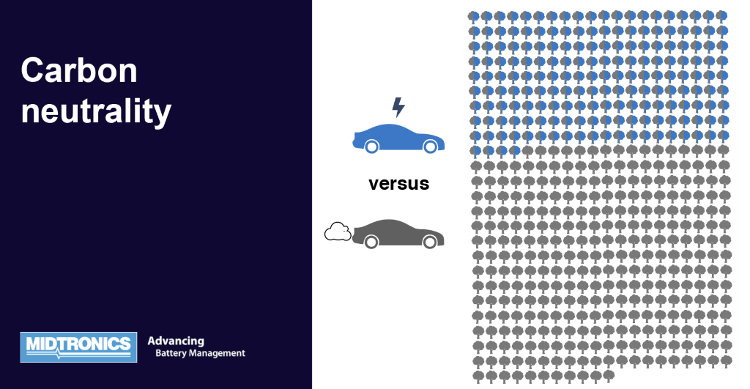
It’s one of those trending topics. But will selling electric vehicles be enough for OEMs to reach their carbon neutrality goals?
Key Takeaways
- Making an EV produces more CO2 than making a gas or petrol car, mostly because of the large battery pack.
- Over its life, an EV can emit far less, especially as more electricity comes from green sources.
- Premature battery failures and full pack replacements cut into an EV’s CO2 advantage.
- Module-level service can repair a pack by replacing only the failed part, which wastes less.
- Carbon neutrality for OEMs depends on a battery strategy that wastes as little as possible, not only on selling EVs.
Carbon neutrality in the automotive industry is influenced by a number of factors. Production emissions, driving emissions, power source and raw material production emissions, as well as investing in CO2 neutralizers (I.e., planting trees), all influence the sum total. One of the main strategies to achieve carbon neutrality is the heavy focus on electric vehicles. So, let’s see how these differ in CO2 emissions to regular gas or petrol powered vehicles.
Cradle to grave
Every new vehicle starts its life in a factory, with production emissions making up a large part of a vehicle’s total lifespan CO2 emissions. For gas and petrol powered vehicles, the production emissions average around 9.000 kg of CO2 per vehicle. For electric these numbers average around 15.800 kg of CO2 per vehicle.
The differentiation between the two, is mostly caused by the large battery packs that are used in electric vehicles. Far more CO2 consuming in production, it’s a good thing that EV’s are relatively ‘green’ in the rest of their lifetime. A gas or petrol powered vehicle will emit some 100.000 kg of CO2 in its average lifetime of 10 years. For EVs that’s about zero. Of course we must note that the power sources, be it gas, petrol or electricity, also emit CO2 in production. But with more and more countries moving to 100% green energy sources, electricity still wins the day.
So what’s the catch? It’s that darn battery. Reading the news, you’ve probably caught onto some mentions of EVs with premature battery failures, costly OE call-backs and so on. With current battery service strategies often still requiring a full battery pack replacement, this sets back the EV when looking at CO2 emissions.
Battery servicing as a green strategy
Before we recycle and turn every faulty battery pack into a supersized battery storage, it’s essential to look at what could prevent such costly and emission unfriendly replacements. Midtronics has found that in many cases an EV battery pack can be repaired by replacing a mere part of it; we’re talking module level service. And with the correct knowledge and tools, you cannot only save yourself the expense of a completely new battery pack. You may also just save a bit of the environment.
Where the Emissions Actually Come From
A vehicle’s carbon footprint isn’t one number. It’s the sum of several stages: building the car, producing the fuel or electricity that powers it, driving it, and dealing with it when it’s done. Each stage looks different for a gasoline car and an electric one.
For a gasoline or petrol vehicle, most emissions come out of the tailpipe, year after year. For an EV, the story shifts toward the front. A large share of its lifetime emissions are locked in before the first mile, because making a battery pack takes a lot of energy and raw material. After that, the car’s emissions depend mostly on how the electricity that charges it is produced. The cleaner the grid, the better the EV looks.
What Happens to a Battery at the End of Its Life
A battery pack doesn’t have to become waste when it’s no longer right for a car. A pack that has lost too much range for driving may still hold useful capacity, and some find a second life as stationary energy storage. When a pack truly can’t be used any more, recycling recovers valuable materials and keeps them out of the waste stream.
Those options beat throwing a pack away, but each one comes after a pack has already been built, used and removed from the vehicle. The most efficient path is the one that keeps the original pack working for as long as reasonably possible.
Why Repair Beats Replacement
When an EV battery fault shows up, the quick answer is often to swap the whole pack. That’s simple for the workshop, but it’s expensive for the owner and costly for the environment, since a new pack means another round of manufacturing emissions.
Many faults are limited to a small part of the pack, such as one weak module out of dozens. If a technician can find that module, replace it and bring it into balance with the others, the rest of the pack keeps working. It takes the right training, safe procedures and diagnostic equipment, but the payoff is a repair that costs less and wastes less.
For OEMs, fleets and dealers with carbon goals, that makes service strategy part of the sustainability plan. Selling more EVs is one piece. Keeping each one on the road with as little waste as possible is the other.
Frequently Asked Questions
Will selling electric vehicles be enough for automakers to reach carbon neutrality?
Not by itself. Carbon neutrality depends on production emissions, driving emissions, the emissions of the power source, raw material production, and offsets such as planting trees. EVs help most in the driving phase, but battery production and replacement need attention too.
Do EVs produce more CO2 to build than gas cars?
Yes. The article estimates production emissions of around 9,000 kg of CO2 for a gas or petrol vehicle and around 15,800 kg for an electric one, mostly because of the large battery pack. EVs make up for it during use, especially as electricity gets greener.
Why does battery replacement matter for an EV’s carbon footprint?
Replacing a whole pack means manufacturing another battery, with the same heavy production emissions. When service strategies still require full pack replacements, each one cuts into the EV’s emissions advantage.
What is module-level battery service?
Instead of replacing a whole pack, a technician replaces only the modules that failed. In many cases an EV battery pack can be repaired this way, which saves the cost of a new pack and avoids producing one.
How can battery servicing be a green strategy?
By preventing unnecessary replacements. Diagnosing the pack, repairing at module level, and extending the life of existing batteries wastes less material and energy than replacing packs, which is why the battery strategy matters as much as the vehicle choice.
Want to become carbon neutral? The answer is not only going EV, its choosing a strategy for the battery where we waste as little as possible. With years of experience we know the path to EV service success, including plenty of know-how on module level service. Learn more about our xEV solutions.
We know the path, we paved it.