
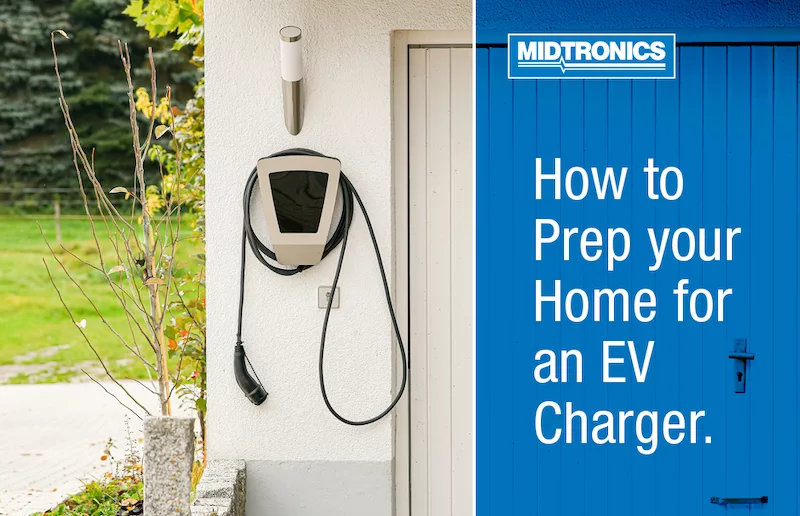
California has mandated that by 2035, sales of gas-burning passenger vehicles will be banned in the state. It’s expected that other states that follow California’s vehicle emissions standards will likely follow suit – places like Colorado, Maine, New York, and Washington. It’s driving the adoption of electric vehicles that are cleaner for the environment and less expensive to drive, but fueling these vehicles isn’t as easy as a five-minute fill-up at a gas station. Although fast-charging stations are popping up, another attraction for EVs is the option to charge your vehicle at home.
Key Takeaways
- A Level 2 EV charger (240V) requires a dedicated circuit — typically 40–50 amps — installed by a licensed electrician.
- The electrical panel must have sufficient capacity to add a dedicated EV circuit; many older homes need a panel upgrade before installation.
- Most EV owners find a 48-amp Level 2 EVSE sufficient for overnight charging — it adds roughly 25–35 miles of range per hour depending on the vehicle.
- Smart charging features — scheduling, energy monitoring, and load balancing — are worth the additional cost for homes with solar or time-of-use electricity rates.
- Installation location matters: indoor garage installation is preferred for cable longevity and safety; outdoor installations require a weatherproof EVSE rated for exterior use.
- Getting multiple electrician quotes and checking utility rebate programs before purchasing the EVSE can significantly reduce total installation cost.
If you’re considering making the switch to an electric vehicle, one of the first things you’ll need to do is prep your home for an EV charger. While EV chargers can be purchased and installed relatively easily, there are a few things you’ll need to take into account before making the purchase.
How Home EV Charging Works
For most EVs, there are commonly three charging protocols that can be implemented to get your battery charged up. The first is a Level 1 charger—a 110/120-volt option which is a standard household plug. The second is a Level 2 charger— a 240V electrical supply that substantially lowers the time it takes to recharge the battery. And the third is fast charging is, of course, Level 3—a fast charging station typically at 400 volts with some up to 800 volts.
For home EV charging, you’ll be pulling power from a residential electrical service that’s not equipped to handle fast charging. It’ll be either a Level 1 or Level 2 charger used.
For Level 1 chargers, often no modifications are required to your home to plug in your car. It uses a normal household outlet, but it can take two days or longer to recharge a depleted battery from 20% to 80%, the recommended level for maximizing battery life.
For Level 2 EV home chargers, you’ll cut the charge time down to under 10 hours, in most cases, although that depends heavily on the charger you select and your available power. It will require electrical work to prep your home or garage.
Analyze Your Power Availability
The average home in the US has an electrical service to its panel of either 100 or 200 amps, and the difference can affect whether your home has the capacity to use an EV charger. An electrical load calculation should be used to determine if there’s enough capacity as is, or if the electrical service needs to be upgraded. As well, space on the panel is necessary for the breaker required for the charger.
A 100A service may have enough room to add a smaller Level 2 EV charger, perhaps at 16A or so. But if you’d like a faster charger, your local electric company may need to install a second service to your garage, running a cost of at least a few thousand dollars.
Depending on your home’s equipment and appliances, a 200A panel may have sufficient space for a larger EV charger, helping you get your battery topped up in much less time and with little infrastructure cost.
Select an EV Charger
The electric vehicle you’d like to own isn’t as much of a factor as it used to be in choosing a home charging station since most have adapters available to work with most or all charging protocols. What’s more important is the amount you’re willing to spend and the rate at which you’d like to charge.
For most manufacturers, you’ll find home EV chargers that range from 16A to 40A. An average 32-amp charger adds around 25 miles of range per hour it’s plugged in, up to 80%, and a somewhat slower rate for the final 20%. That’s often sufficient if you’re going to have your car plugged in overnight.
But if you’d like to maximize the lower energy costs at night, or if you need to charge the battery in a shorter time frame, or if you have more than one EV to charge up, a larger home EV station might be necessary. Options are now available for as high as 80 amps , cutting the charge time in less than half of a 32A charger.
As a rule of thumb, your charger should only use 80% of the electrical capacity available to avoid straining the electrical system. So, if your home has 50A available according to the load calculation, you shouldn’t exceed a 40A charger. If 20A is remaining on your panel, a 16A charger maxes out its capacity.
Route an Outlet to the Charging Location
Next, you’ll need to make sure you have an appropriate outlet installed for your EV charger. EV chargers typically require a dedicated circuit, so you may need to have an electrician install a new outlet before you can use your EV charger.
Two common plug options that are used are NEMA 6-50 and NEMA 14-50. Commonly, welders use a NEMA 6-50 outlet, so there’s a remote possibility your garage is equipped with this plug already. NEMA 14-50 is commonly used for electric ranges in a kitchen or a clothes dryer. The difference between the two is that there’s no neutral wire on the NEMA 6-50 plug. Since the hot blades are spaced differently, they can’t be mistaken for each other.
Other chargers are hardwired to the panel rather than plugged into an outlet. It’s often the case for higher-capacity home EV chargers.
Your electrician will need to route a cable from your panel into the garage on its own circuit. Permits might be required, and working with high-current circuits is best left to the professionals. Make sure the outlet is central so the charging cable can reach your car easily.
Altogether, you can prep your home for an EV for next to nothing if you use a supplied 120V Level 1 charging cable with a standard household outlet, or it could be $5,000 or more if you’re installing a high-capacity charging station. Make sure you determine the available power before buying a new EV charger, then have it professionally installed. By taking these factors into account, you can be sure that you’re prepared to install an EV charger in your home.
Frequently Asked Questions
What electrical work is needed to install a home EV charger?
Installing a Level 2 EVSE (electric vehicle service equipment) requires a dedicated 240V circuit — similar to what a dryer or oven uses. A licensed electrician needs to run wire from your electrical panel to the charger location and install a proper outlet or hardwire the unit. Depending on panel capacity and distance, costs typically range from $300–$1,000+ for installation alone.
Does my electrical panel need an upgrade for an EV charger?
It might. Most Level 2 chargers require a 40–60 amp dedicated circuit. If your panel is near capacity or is an older 100-amp service panel, it may need to be upgraded to 200 amps before a new circuit can be added. An electrician can assess your panel during a pre-installation visit.
What amperage Level 2 charger do most EV owners need?
A 48-amp EVSE (requiring a 60-amp circuit) is the most popular choice — it fully charges most EVs overnight and future-proofs the installation for higher-capacity vehicles. A 32-amp unit works for plug-in hybrids and shorter-range EVs. Avoid oversizing if your panel capacity is limited.
Should I get a hardwired or plug-in Level 2 charger?
Both work. Plug-in models (using a NEMA 14-50 outlet) are portable and can be taken when you move. Hardwired units typically offer higher amperage and look cleaner. If portability matters or you’re renting, plug-in is more flexible. If you plan to stay long-term and want maximum charge speed, hardwired is preferable.
Are there rebates for home EV charger installation?
Yes — many utilities offer rebates for EVSE purchase and installation, and federal tax credits may apply depending on current legislation. Check with your utility company and your state’s energy office before purchasing. Some charger manufacturers also offer rebate lookup tools on their websites.
What should I look for in a smart EV charger?
Look for: Wi-Fi connectivity for scheduling and monitoring, compatibility with your utility’s demand response or time-of-use rate programs, load balancing capability if you have solar or other high-draw appliances, and a mobile app with clear energy usage reporting. Smart scheduling alone can significantly reduce EV charging costs on time-of-use electricity plans.