Conductance Testing FAQ

Conductance Technology FAQ

Conductance testing is now a part of the IEEE standard for testing sealed valve regulated lead acid batteries. Extensive field test results have verified that conductance can be used to measure the capacity degradation of standby batteries. Many telecommunications providers and users of Uninterruptible Power Supply (UPS) systems use Midtronics standby testers to monitor their batteries in service. This acceptance of conductance methodology has resulted in a series of questions about conductance testing. The following are answers to some of the most frequently asked questions.

Please click on a question to reveal the answer.

  • What is conductance?
    Conductance is a unique electrical measurement that determines the ability of a battery to transmit current through its internal structure. As such, it gives a direct relationship to battery power. Internal conductive battery components include battery grids, active material and connectors that conduct electronic current as well as sulfuric acid electrolyte that conducts ionic current between and within the plates and plate separators.
    Conductance is measured by probing the battery with a small AC current ripple that generates a small AC voltage response. Conductance is the relative ratio of the variation in current with the variation in voltage. It is a powerful tool for providing rapid and pertinent battery information without the need of discharging the battery with high currents that can be dangerous and leave the battery in a depleted condition.
    In standby applications, various test data have shown that at low frequencies, the conductance of a battery is an indicator of battery state-of-health showing a linear correlation to a battery's timed-discharge capacity test result. This can be used as a reliable predictor of battery end-of-life.
  • What is ohmic testing technology?
    In simplest technical terms, “ohmic” technology is based on Ohm's law, which expresses the relationship between changes in voltage, current and resistance or conductance in an electrical circuit. Ohm's law can be expressed as follows:
      ΔV = I x R or I / G
        where ΔV is a change in voltage in a circuit
          I is the current in amps
          R is the resistance in ohms
          G is the conductance in siemens
    Thus, ohmic technology in batteries attempts to use measured resistance or conductance values to determine the discharge characteristics of a battery under load. Lower conductance equates to a reduced ability to transmit current for a given drop in battery voltage. Thus the measurement of ohmic factors can be used to assess battery load performance.
  • Why test conductance?
    Through years of laboratory and field-based research, conductance has been found to correlate directly with battery capacity as measured in a timed discharge test. This correlation is nearly linear, meaning that if conductance can be measured, timed-discharge capacity can be predicted as a function of the change in conductance. Since voltage and specific gravity testing are not predictive, timed discharge testing is very time-consuming and expensive, and impedance testing does not correlate directly and linearly with timed discharge capacity. Conductance testing is a very rapid, effective and economical alternative.
  • How is the conductance test performed?
    Simply by connecting the two test set leads to the positive and negative posts of the cell or battery under test, a measurement is taken in a matter of seconds. There is no need for additional leads to be connected to the ends of the string, or for clamp-on current measurements. A conductance measurement, often abbreviated as "G", is displayed in Mhos or Siemens.
  • How can conductance readings be used?
    A significant number of tests on a variety of valve regulated lead acid (VRLA) batteries demonstrate that conductance is predictive of battery state-of-health. Since conductance is directly related, and very nearly linear, with timed-discharge capacity, a reading of the percentage of a known conductance reference value of a new, good battery is a reliable predictor of a capacity test result. The conductance tester gives a quantitative measurement in Mhos (or Siemens), as well as a qualitative indication (percent of reference) of a battery as related to a standard.
  • Are conductance readings difficult to interpret?
    Unlike other testing techniques that require interpretation and mathematical calculation, conductance readings can be read instantly and can be related directly to the condition of the battery being tested.
  • Since the qualitative conductance test requires a standard, how can that standard be established?
    The most effective method for the establishment of a standard requires the performance of a timed discharge test to locate a cell or battery that performs to 100% of the rated discharge capacity. A conductance test can then be performed and a reference established. A sample of 30 or more new batteries can also be used to establish a standard. Without a set reference value, conductance testing can still be utilized to trend state of health, as batteries can be monitored through periodic conductance readings and the observation of deterioration over time.
  • Will the battery manufacturer have reference numbers for my batteries?
    Many battery manufacturers now publish conductance reference or base-line values. If not, a specific reference value can be established during installation for a new, healthy battery. An average can also be used from a sample of batteries of the same model, manufacture date, installation date and service history as detailed in the operating guidelines and instruction manuals. Midtronics testers also provide tools for the establishment of reference values. Refer to the instruction/operating manual for more information on these features.
  • Can Nickel Cadmium (NiCd) batteries and cells be tested utilizing conductance?
    The Celltron-type testers from Midtronics will accurately measure the voltage and conductance of Nickel Cadmium batteries. Conductance will measure and identify gross failures of NiCd batteries. The Celltron will report hard shorts identified through low-voltage, and is a useful tool in testing the application of NiCd battery systems.

    The feature of identifying the decline and forecasting the failure of battery cells, a superior feature of Midtronics technology, is not as applicable when testing NiCd’s. Based upon their construction and chemistry, all NiCd’s will measure consistently (good) until there is a gross failure indicating the end of life. Midtronics technology will indicate this gross failure after the fact, a limitation that is true of all ohmic measuring devices, including all existing impedance and resistance testers on the market.

    As mentioned above, Midtronics testers contain a low voltage alarm, settable by the user to a minimum of 1.50 volts DC cell. The tester will report an audible alarm when testing single cell NiCd’s falling below the voltage benchmark. Additionally, the tester will not test any battery or cell where the measured voltage is below 1.0 Volts DC, which would include any badly discharged or shorted NiCd cells.

    For more information on the testing, trending and analysis of NiCd batteries, please contact Midtronics.
  • Can a Midtronics conductance test be made while the battery is on float?
    Yes. The current test technology enables successful testing of batteries while on float charge. Midtronics Celltron testers, and in particular the Celltron ULTRA, have extensive electrical noise rejection filtering so that good battery data can be taken even with high voltage ripple on the circuit. In certain cases an excessive amount of electrical noise current can interfere with any test method, but Midtronics testers determine if that has happened to prevent bad data from being generated.
  • Does the Midtronics conductance tester need to be plugged into AC power?
    No. Midtronics Conductance testers require no external AC power. Midtronics testers derive test power by removing a small load from the battery under test. Additionally, the testers are powered by an on-board support battery for the test data review, test configuration, portable printing and transfer to PC.
  • Can the signal from the Midtronics conductance tester interfere with or damage electronic equipment or cause danger to a defective cell?
    No. Midtronics conductance testers do not apply a large current to the battery under test, as does other test equipment. Midtronics testers apply a low current signal frequency to the cell or battery in a circuit; therefore, it is highly unlikely that damage to sensitive electronic equipment could result from an inrush to balance the load. Testing on communication systems shows that conductance testing does not interfere with telephone signals. Users should be aware that other types of battery test equipment (non-conductance methods) do use AC power and many send a large current though the battery, which may affect sensitive electronic devices.
  • How large are Midtronics conductance testers?
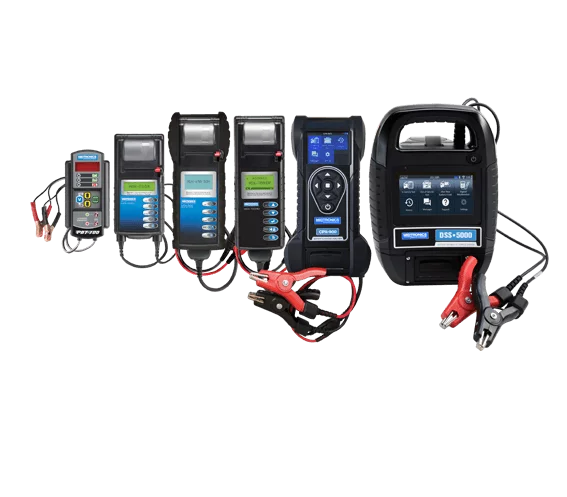
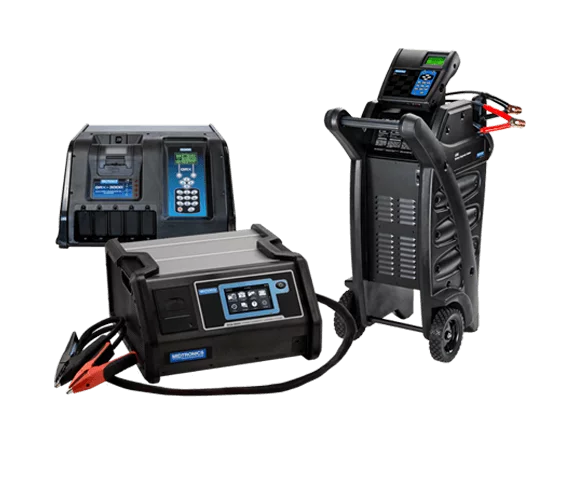
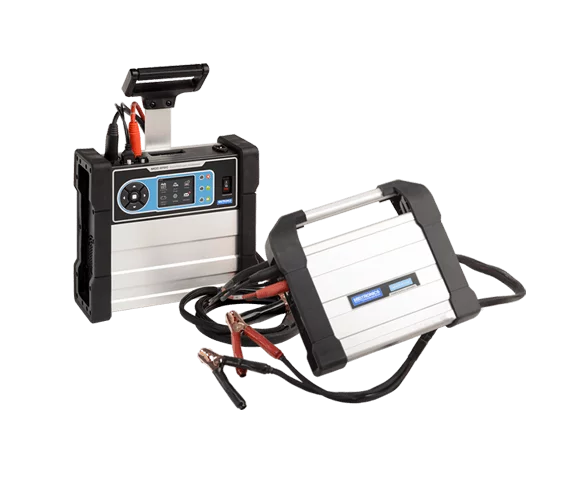
    All Midtronics conductance testers are hand-held portable instruments. They are built to very rugged, yet weigh less than 2 pounds (1 kilogram) each. The testers are easily transportable and each includes some form of protective carrying case.
  • How long has the Midtronics conductance test method been used for testing batteries?
    The original technology was developed by Motorola in the 1970’s for testing automotive batteries. Today's products include many new patents in North America, Europe and Japan. Midtronics has been developing and manufacturing conductance testers for more than 20 years, and customers include the world's major battery manufacturers, major automotive manufacturers, telecommunications providers, electric power utilities, UPS manufacturers and organizations in a variety of other industries. Midtronics has manufactured tens of thousands of battery conductance testers under the Micro, PowerSensor™, Midtron®, and Celltron® brands, as well as various private labels. Our products are manufactured and used extensively throughout the globe, making Midtronics the world leader in battery management technology.
  • Has conductance testing been proven and accepted by the international community?
    Yes. Extensive data has been gathered by the global telecommunications industry, battery manufacturers worldwide, international rail and transportation providers, and the electric power industry. This data has been presented to the IEEE Standards Committee, which now includes conductance testing in its standard for testing sealed valve-regulated batteries. Additionally, conductance is recognized as a testing method for starting batteries in the Battery Council International Service Manual. Developments in testing and monitoring have been presented at numerous industry conferences.
  • What is the optimal point of contact when making a conductance test?
    Making direct contact with the lead post will usually provide the most consistent and accurate test result. In order to facilitate this contact (which can be difficult depending on the battery post design), Midtronics offers a variety of battery test interfaces, including clamps and contact probes of differing sizes. Contact with stainless steel post hardware will skew test results. It may be helpful for the user to experiment with different battery post designs to identify which test contact location provides the best conductance result.
  • What is a Kelvin connection and why is it needed for accurate conductance measurement?
    The Kelvin connection refers to any four-point connection electrical test interface. Two points are used for test signal injection and two separate points without any load are used for detection circuitry. It provides an electronic method to reduce the affect of the variable resistance of the test interface that would occur if the signal injection and detection occurred at the same points. It is used to ensure the most accurate conductance measurements possible.
  • Does battery temperature effect conductance measurement?
    The Kelvin connection refers to any four-point connection electrical test interface. Two points are used for test signal injection and two separate points without any load are used for detection circuitry. It provides an electronic method to reduce the affect of the variable resistance of the test interface that would occur if the signal injection and detection occurred at the same points. It is used to ensure the most accurate conductance measurements possible.
  • Can the data collected by the Celltron technology be manipulated by PC?
    Yes. Midtronics offers PC software that facilitates the downloading and manipulation of data collected with the Midtronics test equipment. Data can be presented in a graphical format and can be utilized for trend analysis as well as historical archiving. An infrared strip printer is also available for on-site printing and record keeping. Some software upgrades can be downloaded over the Internet at www.midtronics.com.