
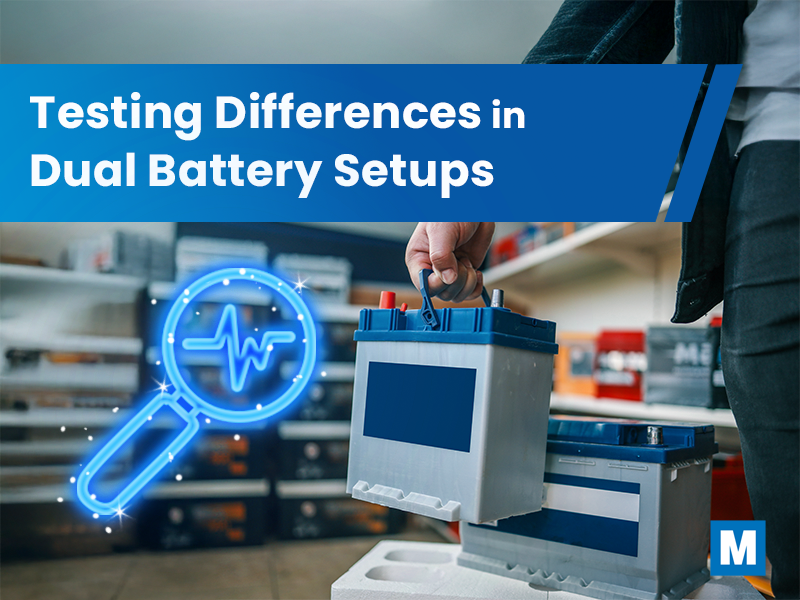
If you’ve ever opened the hood on a heavy-duty diesel truck or RV and found two batteries staring back at you, you know dual-battery setups don’t play by the same rules as single-battery systems. For accurate testing, proper diagnosis, and preventing those dreaded customer comebacks, it’s key to know how to deal with dual batteries effectively.
Key Takeaways
- In a parallel dual-battery system, a weak battery can hide behind a strong one, testing the combined system may show acceptable readings while one battery is failing.
- You must disconnect the parallel connection and test each battery individually to get accurate results. There’s no shortcut that skips this step.
- Deep-cycle auxiliary batteries in isolated systems should not be evaluated against starting battery standards, they’re different designs serving different roles.
- Replacing only one battery in a parallel system creates an age and resistance mismatch that accelerates wear on the new battery and often leads to premature failure.
- Corroded terminals and undersized cables affect test results in dual systems just as much as the batteries themselves, always check connections before concluding a battery is the problem.
- Conductance testing identifies subtle performance differences between batteries before either reaches complete failure, which is especially valuable in parallel configurations.
Why Two Batteries in the First Place?
Dual-battery systems exist because of power demands. Diesel engines need massive cranking power, especially in cold weather. Commercial vehicles run accessories, power inverters, and lift gates. RVs and marine vessels need onboard or cabin systems independent from engine starting.
The solution is to add a second battery, but not all dual-battery setups work the same way. Some wire batteries in parallel, creating one big battery with combined capacity. Others keep them isolated, with separate starting and accessory batteries. Some use automatic combiners that switch configurations based on vehicle needs.
Each configuration has unique testing requirements, and if you treat them all the same, it leads to diagnostic problems.
The Parallel Problem
When two batteries are wired in parallel (positive to positive, negative to negative), they act as a single unit with double the capacity. Sounds simple enough, but there’s a catch: they only work properly when they’re well-matched. If one battery is significantly older, weaker, or even just a different type than its partner, the stronger battery ends up carrying the load for both.
Testing parallel batteries presents a unique challenge. When you connect a tester to one battery, you’re actually seeing the combined behavior of both batteries working together. A weak battery can hide behind a strong one, making it nearly impossible to identify which battery is failing. The voltage readings will look like they’re within spec because the good battery is compensating. Even load testing can be misleading as the healthy battery temporarily masks the weak battery’s inability to hold up under stress.
This is why testing each battery individually is crucial. You need to physically disconnect the parallel connection temporarily to see what each battery is really capable of on its own. It might seem like extra work, but it’s the difference between replacing one failing battery versus replacing both unnecessarily or, worse, missing the problem entirely and having the customer break down a week later.
The Challenge of an Isolated Battery
Isolated dual-battery systems keep batteries separate, usually with one dedicated to starting and the other powering accessories. These systems use isolators, automatic combiners, or manual switches to manage how batteries interact.
Testing isolated systems requires evaluating each battery for its specific role. The starting battery should be tested against engine cranking demands, while the auxiliary battery needs to be tested based on its deep-cycle requirements. These might even be completely different battery chemistries with different testing criteria.
Understanding each battery’s role helps you interpret test results correctly. Many technicians test both batteries against the same standards, but this creates problems. A deep-cycle auxiliary battery shouldn’t be judged by starting battery standards. A healthy deep-cycle battery might show lower cold cranking amps than expected from a starting battery, which is normal for its purpose.
The Age and Type Mismatch Issue
Here’s a common scenario: a customer has one dead battery in their dual-battery truck. The natural instinct is to replace just the failed battery. But mixing a new battery with an old one in a parallel configuration causes problems.
The new and old batteries will have different internal resistances and charge acceptance rates. During charging, the new battery reaches full charge faster. During discharge, it provides more of the load. This imbalance accelerates aging of the new battery and can lead to premature failure.
Battery type mismatches create similar issues. Mixing flooded batteries with AGM, or using batteries with significantly different capacities, throws the system out of balance. The batteries fight each other rather than working together.
When testing dual-battery systems, checking both age and type provides some needed context. Mismatched batteries might explain unusual test readings or predict future problems even if both currently pass basic tests.
Getting Accurate Test Results
Start by identifying the configuration. Is it parallel or isolated? Are the batteries the same type and age? Once you know what you’re working with, develop the right testing flow.
For parallel systems, disconnect the parallel connection and test each battery individually. Yes, it takes more time, but it’s the only way to see each battery’s true condition. Test both against their rated specifications, not against each other.
For isolated systems, test each battery in its specific role using the right parameters for starting versus deep-cycle batteries. Check isolator or combiner operation as well since faulty isolators can prevent proper charging or create parasitic drains.
Conductance testing provides advantages over traditional methods. Advanced testers like Midtronics’ MVT identify subtle differences in battery condition before complete failure, giving you the diagnostic detail needed for confident recommendations.
Common Mistakes to Avoid
The biggest mistake is testing only one battery and assuming the other is fine. Both batteries need evaluation, period.
Another error is replacing one battery without considering the impact on the other. In parallel systems especially, replacing just one battery when both are old creates the age mismatch problem discussed earlier. Sometimes the right answer is recommending both batteries be replaced together. And perhaps if one battery is marginal or good but older, the customer can take it for use in another application or as a backup.
Finally, don’t forget connections between batteries and cables leading to them. Corroded terminals, loose connections, or undersized cables affect test results and system performance. These issues can make good batteries appear weak or cause premature failure.
Making the Right Call
Dual-battery systems are increasingly common across multiple industries, from commercial fleets to recreational vehicles to marine applications. Understanding how to properly test these configurations sets you apart as a technician or shop who really knows their stuff. It prevents diagnostic mistakes, reduces comebacks, and builds customer trust when you can clearly explain what’s happening with their batteries and why your recommendations make sense.
The extra time spent testing dual-battery systems properly pays dividends in accuracy and customer satisfaction. And with the right diagnostic equipment, that extra time becomes minimal while your confidence in the results goes way up.
Ready to tackle dual-battery diagnostics with confidence? Midtronics provides advanced battery testing solutions designed to handle your equipment. Get detailed insights you need to accurately assess battery health in single battery, parallel, and isolated systems, helping you make the right call every time.
Frequently Asked Questions
How do you test a parallel dual-battery system accurately?
Disconnect the parallel connection between batteries and test each one individually against its rated specifications. Testing the combined system with both batteries connected shows you what the stronger battery is masking. It takes more time, but it’s the only way to see each battery’s true condition.
Can you replace just one battery in a parallel dual-battery setup?
Technically yes, but it’s often not the right call. Mixing a new battery with an old one in parallel creates a resistance mismatch, the new battery charges faster and carries more of the load, which accelerates its aging. If both batteries are old and one has failed, the recommendation for both batteries together is the honest and technically sound one.
What’s the difference between a starting battery and an auxiliary deep-cycle battery in an isolated system?
Starting batteries are designed to deliver a short, powerful burst of current for cranking. Deep-cycle batteries are designed for steady, sustained discharge over longer periods. They have different internal plate designs, different CCA ratings, and different testing criteria. Evaluating a deep-cycle auxiliary battery against starting battery standards will produce misleading results.
How does a faulty isolator or combiner affect dual-battery testing?
A failed isolator can prevent the auxiliary battery from charging properly, making it appear weak even if the battery itself is healthy. A combiner stuck in the wrong position may keep batteries connected when they should be isolated. Always check isolator and combiner operation as part of dual-battery diagnosis, the control device is as much a part of the system as the batteries.
What vehicles commonly use dual-battery systems?
Heavy-duty diesel trucks, RVs, marine vessels, and many commercial vehicles. They’re also increasingly common in work trucks with high accessory loads, power inverters, lift gates, work lighting. Heavy-duty diagnostic tools designed for dual-battery configurations handle the specific testing requirements these systems demand.
Why do dual-battery failures often get misdiagnosed?
Because testing the system as a whole shows the combined behavior of both batteries. A strong battery compensates for a weak one well enough to pass a basic test. The symptoms, slow cranking, intermittent starting issues, look identical to a single weak battery. Without testing each battery independently, the weak one stays hidden until it fails completely, usually at the worst possible time.