
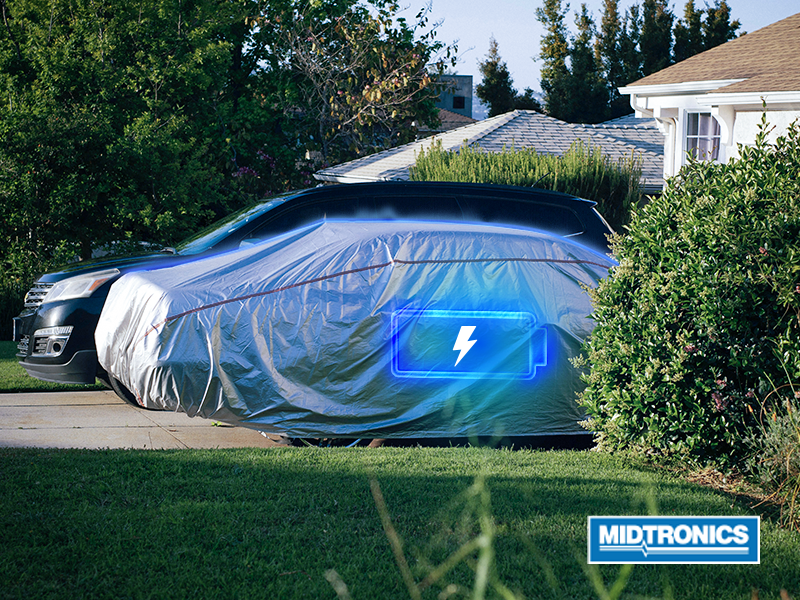
Vehicles in long-term storage still place demands on their 12-volt batteries, even when the ignition stays off for weeks or months. Parasitic loads, self-discharge, temperature, and existing battery condition can eventually reduce the state of charge enough to cause starting problems or damage the battery. The right approach depends on how long the vehicle will sit, whether an electrical outlet is available, and how quickly it needs to be ready for service again. For dealerships, fleets, and repair facilities, a pre-planned battery maintenance routine can prevent a lot of dead batteries when stored vehicles are needed again.
Why Batteries Discharge During Storage
Parking a vehicle doesn’t completely disconnect its battery. Security systems, keyless entry, telematics, memory functions, and control modules can continue using small amounts of power after shutdown. Under normal driving conditions, the charging system replaces that energy, but put the same vehicle in the back corner of a dealership lot for four months, and the situation changes.
This can be particularly relevant for seasonal inventory. A dealership in a colder climate may hold convertibles, sports cars, or other summer vehicles through the winter, anticipating stronger demand in spring. Some may barely move or not at all until the snow melts.
Meanwhile, the battery continues to self-discharge while the vehicle’s loads consume energy. How quickly state of charge falls depends on the battery, vehicle, temperature, and storage conditions.
Start Storage with a Healthy Battery
The best time to find a battery problem is before the vehicle gets parked.
Testing finds whether the battery is healthy, needs charging, or is already showing signs of deterioration. A healthy battery that’s only partially charged should also be addressed before storage. Starting with a low state of charge leaves less reserve for the weeks or months ahead.
For dealerships and fleets managing many vehicles, documenting that initial test creates a useful baseline. If a vehicle goes into storage with a healthy, fully charged battery but loses charge faster than similar vehicles, it’s a reason to investigate rather than simply connecting a charger every time it goes dead.
It also prevents an already marginal battery from disappearing into storage only to become a no-start several months later.
Maintain Charge When the Vehicle Is Parked
Battery maintenance can be one of the simplest ways to manage stored vehicles, especially when electrical power is readily available. A battery maintainer monitors battery condition and provides current as needed rather than continuously applying an uncontrolled charge. Charging equipment needs to be right for the battery technology, whether the vehicle uses a conventional flooded lead-acid, AGM, or lithium. Maintainers can be especially useful for showroom vehicles, collector cars, specialty inventory, and other vehicles stored where power is easily accessible.
Manufacturer procedures matter, too. Some vehicles dictate particular charging connection points that must be followed rather than connecting equipment wherever it’s most convenient like jump-start points.
The situation is different when 30 seasonal vehicles are parked at the far end of an outdoor dealership lot. Running maintainers to every vehicle probably isn’t practical. That’s where scheduled testing and charging become more useful.
Build a Routine for Larger Groups of Stored Vehicles
A dealership or fleet doesn’t necessarily need to treat every stored vehicle the same way.
How frequently a battery needs attention can depend on its initial condition, the vehicle’s electrical demands, storage temperature, and how long it will remain parked. Instead of waiting for vehicles to stop starting, shops can establish periodic checks and charge batteries when testing indicates it’s necessary.
A basic storage plan should consider:
- How long the vehicle will remain parked
- Battery condition and state of charge when storage begins
- Known key-off electrical loads
- Temperature and storage conditions
- Access to charging equipment
- How quickly the vehicle may need to return to service
Testing gives staff actual information to work from. That’s much more useful than walking the lot every few weeks and starting vehicles simply because they’ve been sitting.
Should You Disconnect Batteries During Storage?
Disconnecting the battery can reduce key-off electrical draw, but it’s not automatically the best choice. Some of today’s vehicles rely on continuous battery power for stored settings, learned values, security systems, and more. Disconnecting power can affect those systems and may require more in-depth service or calibration when the battery is reconnected.
For dealerships, there are practical considerations as well. Inventory tracking, remote access, or other connected services may need to remain operational while the vehicle is parked.
Starting the Engine Isn’t the Same as Charging the Battery
One old habit is to periodically start every stored vehicle and let it idle for a few minutes. That’s not necessarily doing the battery much good. Starting the engine requires a significant amount of battery energy. The vehicle then needs enough operating time and the right charging conditions to replace that energy while its electrical systems continue to draw power. A quick start and short idle doesn’t restore what was consumed.
If vehicles are being periodically driven for other maintenance reasons, that’s a different situation. But for battery care alone, testing and charging provide a much clearer picture than assuming a short engine run topped off the battery.
Getting Seasonal Inventory Ready to Sell Again
Long-term battery care becomes particularly important when seasonal vehicles are brought back into active inventory.
Consider those sports cars and convertibles that were parked before winter. When spring arrives, the dealership may want to photograph them, move them to display areas, schedule test drives, and have them ready for customers in a hurry. Finding several dead or questionable batteries at that point creates unnecessary work right when the vehicles need to be sale-ready.
Battery testing should be part of the process of bringing stored inventory back online.
Check state of charge and battery condition before assuming that a successful start means the battery is ready. If test records were kept before and during storage, compare them with the current result. A battery that still starts the engine may still show less-than-ideal health after months of limited use.
This is also a good time to inspect battery connections and confirm the charging system is normal. The goal is to address battery concerns before the vehicle reaches the customer. A convertible that needs a jump-start five minutes before a spring test drive isn’t a great first impression.
Make Battery Care Part of the Storage Plan
Long-term storage shouldn’t mean parking a vehicle and hoping the battery survives until it’s needed again. Test the battery before storage, start with an appropriate state of charge, and choose a maintenance strategy that fits the vehicle and facility.
Midtronics solutions can help dealerships, fleets, and service facilities manage battery condition before, during, and after storage. Consistent testing and controlled charging make it easier to identify deteriorating batteries early and get stored vehicles back into service without a last-minute scramble.
FAQs/People Also Ask
- How long can a vehicle sit before its battery goes dead?
There’s no fixed timeframe. Battery condition, temperature, key-off loads, and vehicle design all influence how quickly state of charge falls.
- Should dealerships use battery maintainers on stored inventory?
Maintainers can work well when power is available. Larger outdoor inventories may be better suited to scheduled testing and charging.
- Should batteries be disconnected during long-term storage?
Only when appropriate for the vehicle. Disconnecting power can affect security systems, telematics, learned values, and other electronic functions.
- Is periodically starting a stored vehicle enough to maintain its battery?
Not necessarily. A brief idle may not replace the energy consumed during starting and by the vehicle’s electrical systems.
- What should be checked when a stored vehicle returns to service?
Test battery condition and state of charge, inspect connections, and confirm normal charging-system operation before returning the vehicle to regular use.
- Should seasonal dealership inventory be tested before going back on sale?
Yes. Testing can identify batteries that lost charge or deteriorated during storage before the vehicle is displayed, demonstrated, or delivered.