
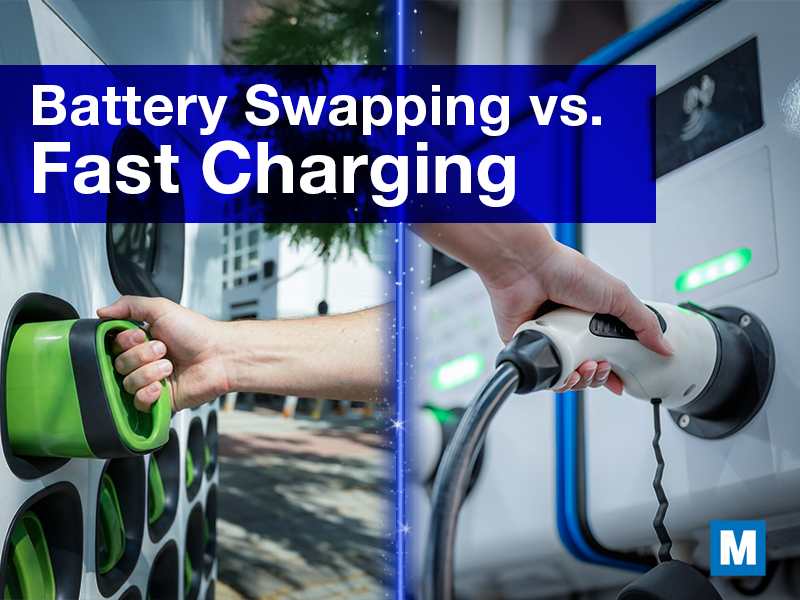
As electric vehicles continue their march toward mainstream adoption, the infrastructure supporting them faces a critical question, namely how will drivers recharge their vehicles quickly and conveniently? Two competing visions have emerged – battery swapping and fast charging – each offering distinct advantages and challenges that will shape the future of EV ownership and service.
Key Takeaways
- Battery swapping targets fleet operations and markets with manufacturer cooperation and government support. Fast charging is positioned for the broader consumer market, where it benefits from network effects and existing infrastructure investment.
- Battery swap standardization remains the biggest unresolved challenge, battery pack designs vary dramatically across manufacturers, and no universal standard exists.
- Fast charging speeds have improved dramatically, today’s fastest systems add 200+ miles in 15 to 20 minutes, with solid-state batteries potentially enabling 80% charges in 5 to 10 minutes.
- In a battery swap model, pack health diagnostics are centralized with the swap station operator. In a fast-charge model, battery health management falls to vehicle owners and their service providers.
- Because batteries are the most expensive EV component, accurate state-of-health diagnostics are critical under either infrastructure model for valuation, warranty, and service decisions.
- Both approaches represent real improvements over Level 2 charging for long-distance travel, the infrastructure question is increasingly about market segment and use case, not which technology ‘wins.’
The Battery Swapping Vision
Battery swapping technology promises the holy grail of EV convenience: refueling times comparable to traditional gas stations. Rather than waiting for batteries to charge, drivers pull into stations where depleted battery packs are removed and replaced with fully charged units in minutes.
Companies like in areas overseas have already deployed networks of battery swap stations, demonstrating that this technology is viable. Their automated stations can complete a battery exchange in approximately three to five minutes, offering a user experience remarkably similar to conventional refueling. More locally, a carmaker experimented with the concept years ago but ultimately preferred a fast-charging network instead.
The appeal extends beyond speed. Battery swapping separates battery ownership from vehicle ownership, potentially reducing upfront EV costs. Drivers could subscribe to battery services, upgrading to higher-capacity packs as technology improves without replacing their entire vehicle. This model could accelerate EV adoption by making the vehicles more affordable and future-proof.
Fleet Implications
For fleet operators, battery swapping offers compelling advantages. Commercial vehicles operating on tight schedules cannot afford lengthy charging sessions. Delivery vans, taxis, and rideshare vehicles could maintain near-constant operation with quick battery exchanges, making it extremely productive with incredible return on investment.
However, battery swapping faces significant hurdles. Standardization remains the biggest challenge. Unlike charging ports, which have merged around a few standards, battery pack designs vary dramatically across manufacturers. Creating universal swapping stations would require cooperation in the industry and potentially compromise vehicle design flexibility. Each station would need to stock multiple battery types and sizes, creating inventory and space challenges.
The infrastructure investment is substantial, too. Swap stations require sophisticated robotics, real-time battery management systems, and a substantial footprint. They’d need to maintain large inventories of expensive battery packs, with each station representing millions in capital expenditure. At the moment, geographic coverage is still limited, concentrated in specific markets where government support and single-manufacturer ecosystems exist.
The Fast Charging Evolution
Fast charging has emerged as the more widely adopted solution, building on the familiar method of traditional refueling while using existing electrical infrastructure. The technology has evolved rapidly, with charging speeds increasing dramatically. Today’s fastest systems can add 200+ miles of range in 15 to 20 minutes, and next-generation chargers promise even shorter times.
The charging network infrastructure has expanded aggressively, but fast charging’s greatest advantage lies in its flexibility. Chargers require relatively modest space and can be installed at diverse locations including rest stops, shopping centers, restaurants, and parking structures. This distributed approach allows them to be naturally integrated into existing commercial spaces, making charging a complementary activity rather than a dedicated stop.
Looking Forward to Solid State
Technology continues advancing. Solid-state batteries promise even faster charging capabilities, potentially enabling 80% charges in five to ten minutes. Improved thermal management systems are extending battery life despite frequent fast charging. Wireless charging technology, though currently limited to slower speeds, could eventually enable hands-free fast charging in the future.
Challenges remain, though. Even the fastest charging requires significantly more time than refueling or battery swapping. Battery degradation from frequent fast charging remains a concern, although battery management systems have substantially mitigated this issue. Grid capacity poses questions in areas with aging electrical infrastructure, requiring utilities to invest in upgrades to support fast-charging installations that have more than one or two units.
Consumer Experience Considerations
For consumers, the choice between these technologies presents different benefits. Battery swapping offers predictability and speed but requires drivers to locate specialized stations that may be geographically limited. The subscription model could appeal to cost-conscious buyers but some will waffle at ongoing service fees.
Fast charging provides flexibility and growing ubiquity. Drivers can charge at numerous locations, often combining charging stops with other activities. The user owns their battery pack, eliminating subscription concerns, but they carry the cost of battery replacement and degradation down the road.
Range anxiety is addressed differently between the approaches. Battery swapping’s quick turnaround eliminates this concern entirely within coverage areas, while fast charging reduces it without completely eliminating the time investment. Both represent significant improvements over Level 2 charging for long-distance travel, so long as there is access.
Service and Maintenance Implications
From a vehicle service perspective, these technologies both change how service looks. Battery swapping centralizes battery maintenance with service providers managing pack health, diagnostics, and replacement cycles. This creates opportunities for specialized battery service centers equipped with advanced diagnostic equipment to monitor pack health, balance cells, and predict maintenance needs.
Fast charging places battery health management primarily with vehicle owners and their service providers. Diagnostics become crucial for monitoring battery condition, assessing SoH, and optimizing charging protocols. Service technicians require tools to evaluate battery health, identify potential issues, and provide accurate range predictions.
As batteries represent the most expensive EV component, accurate diagnostics become essential for vehicle valuation, warranty claims, and service recommendations.
What’s Ahead?
The future likely holds room for both technologies in different applications. Battery swapping may dominate fleet operations and specific markets with strong government support and manufacturer cooperation. Fast charging appears positioned to serve the broader consumer market, benefiting from network effects and infrastructure investments already underway.
Hybrid approaches may emerge. Some vehicles could support both fast charging and battery swapping, offering flexibility based on location and circumstances. Smart charging systems might optimize between various charging speeds based on grid conditions, battery health, and driver schedules.
Ultimately, the winning approach may be determined less by which technology is better than by economics, regulatory environments, and consumer preferences that vary by market and use case.
Stay Ahead of EV Battery Technology
As EV infrastructure evolves, having the right diagnostic and service equipment becomes essential. Midtronics provides industry-leading battery testing and diagnostic solutions designed specifically for the demands of modern electric vehicle batteries. From comprehensive battery health analysis to advanced diagnostic capabilities, our equipment helps service professionals deliver accurate assessments and maintain battery performance. Count on us to be there as you explore EV battery service solutions and to ensure your facility is prepared for the electric future.
Frequently Asked Questions
How fast is a battery swap compared to DC fast charging?
Battery swap stations can exchange a depleted pack for a fully charged one in approximately 3 to 5 minutes, comparable to conventional gas station refueling. DC fast charging at 150 to 250 kW can add 200 miles of range in 15 to 20 minutes. Next-generation systems and solid-state batteries could push fast charging to 80% in 5 to 10 minutes, closing the gap further.
What’s the main obstacle preventing battery swapping from scaling globally?
Standardization. Battery pack dimensions, connectors, and BMS protocols vary dramatically across manufacturers. A universal swap station would need to stock multiple pack types and maintain the robotics to handle all of them. This is why battery swapping has mostly been deployed within single-manufacturer ecosystems or specific commercial vehicle categories where standardization can be enforced.
Who manages battery health in a swap-based model versus a fast-charge model?
In a swap model, the station operator manages a rotating inventory of packs, handling diagnostics, cell balancing, and replacement centrally. In a fast-charge model, battery health management is the vehicle owner’s responsibility, supported by their dealer or service provider. Both models create demand for accurate battery health assessment, the difference is in who performs it and where.
Does frequent DC fast charging degrade the battery faster than Level 2 charging?
Repeated fast charging at high temperatures does contribute to accelerated degradation, but modern battery management systems have substantially mitigated this. The practical concern is fast charging when the battery is cold, which can cause lithium plating if the pack isn’t preconditioned. Controlled charging conditions and proper thermal management matter more than the charging speed itself.
What does battery swapping mean for EV service departments?
In swap ecosystems, individual vehicle batteries are managed by the swap operator, service departments interact with diagnostic data from the BMS rather than physically handling the pack for maintenance. Fast-charge vehicle service keeps battery health management at the dealership or independent shop level, requiring tools and training to assess EV battery state of health, support warranty claims, and guide replacement decisions.
Are battery swap networks being built in the United States?
Limited deployment exists, primarily in fleet and commercial vehicle contexts. Consumer-facing battery swap for personal vehicles hasn’t gained significant traction in North America, where fast-charging networks have been the dominant investment. Fleet operators running taxi, rideshare, or delivery vehicles in defined geographic areas are the most likely early adopters if swap infrastructure expands domestically.