
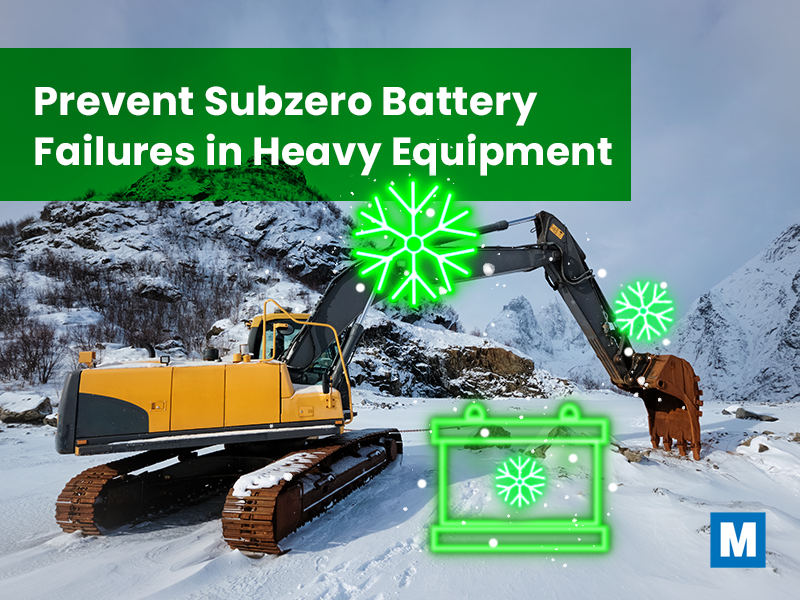
Picture this: temperatures hit subzero, and your excavator won’t start. What starts as a $150 battery problem quickly snowballs into thousands in lost productivity and missed deadlines. For anyone counting on heavy equipment to keep projects moving, a dead battery isn’t just annoying but a real threat to your bottom line. Whether you’re running a single machine or managing an entire fleet, you need to stay ahead of cold-weather battery failures before they shut you down.
Key Takeaways
- At 0°F, a fully charged battery loses about half its cranking power while the engine simultaneously requires twice as much power to turn over, a combination that catches marginal batteries by surprise.
- Long idle periods during weather delays or seasonal shutdowns accelerate sulfation. Batteries that were healthy at shutdown can be too far gone to recover by the time the equipment is needed.
- Proactive fall testing establishes the baseline that makes winter decisions data-driven instead of reactive. Replace on your schedule, not in an emergency.
- Any battery testing below 80% of rated CCA should be flagged for replacement. Batteries showing consistent downward trend in conductance readings are approaching end-of-life regardless of current pass/fail status.
- For remote job sites, portable high-capacity jump starters designed for commercial equipment eliminate the need for a second vehicle and cut downtime significantly.
- Battery maintenance programs cost a fraction of one major equipment failure, the ROI calculation isn’t close.
How Cold Weather Attacks Heavy Equipment Batteries
Cold weather hits batteries hard. When temperatures drop to 0°F, your fully charged battery loses about half its cranking power. Meanwhile, your engine needs twice as much power to turn over because the oil thickens up and everything moves slower. It’s a double whammy that creates the perfect recipe for failure.
Heavy equipment batteries face tougher challenges than your average pickup truck. Those massive diesel engines in excavators, haul trucks, and other heavy iron demand serious cold cranking amps, and it could be 1,000 CCA or more. Then pile on the constant drain from block heaters, glow plugs, cab heaters, and work lights. There’s barely any room for error.
Long periods of sitting idle make things worse. Your equipment waits through weather delays, weekends, or seasonal shutdowns, and the whole time, batteries are slowly dying. Cold speeds up sulfation, which can permanently kill capacity. By the time you need that machine to fire up, your once-healthy battery might be too far gone to recover.
What Battery Failure Really Costs You
The direct costs are easy to count: emergency service calls, new batteries, and tech labor. A single remote location failure can easily hit $500 to $1,000.
But that’s nothing compared to the ripple effects. One dead excavator stops your entire crew. What started as $150 in battery costs becomes a $10,000 lost day. In mining, one dead haul truck backs up the whole operation. In agriculture, losing even one day during harvest can mean watching crop quality and your profit deteriorate.
Running a fleet? When a cold snap hits and multiple units go down at once, your maintenance team gets overwhelmed fast. Equipment sits longer than it should. Schedules fall apart. Customer relationships take a hit. It all compounds.
Get Ahead of Problems with Proactive Testing
Stop waiting for batteries to die, and get proactive instead. Visual checks catch obvious problems like corroded terminals, but they can’t tell you what’s happening inside a battery that’s about to fail.
Modern conductance testing changes the game. It works by sending a small signal through the battery and reading how it responds. This tells you exactly what shape your battery is in without stressing it or waiting for a full charge. It’s accurate, fast, and won’t damage anything.
Test your batteries in the fall while they’re still performing well, and keep a record either in the equipment or in the service records. This gives you a baseline to work from. You’ll spot weak batteries before winter hits, which means you can replace them on your schedule instead of scrambling in an emergency.
Best Practices for Cold Weather Battery Maintenance
Build a solid cold-weather maintenance routine that covers all the bases.
Inspect Everything Thoroughly
Don’t just test the battery but check every connection point. Make sure terminals are clean and torqued right. Corrosion creates resistance that makes cold weather starts even harder. Inspect your cables too since frayed, damaged, or undersized cables can’t deliver the full power your battery provides.
Keep Batteries Charged
Equipment that sits for a while needs battery maintainers or trickle chargers. These prevent the slow drain that happens in storage and keep batteries ready to go. If you’re running block heaters, make sure you have enough charging capacity. You don’t want your block heater sucking the battery dry overnight.
Use Battery Heaters When You Need Them
Battery blankets and heaters keep your batteries warm enough to crank strong in extreme cold. When you’re putting seasonal equipment away, charge batteries fully, disconnect the negative terminal to stop parasitic drain, and store in climate-controlled space if you can.
Smart Testing Tools and Protocols
Today’s battery testers do way more than measure voltage. Professional-grade equipment gives you real data to make smart decisions with. Modern testers measure CCA, run full health assessments, and predict how much life your batteries have left.
Standardize your testing across all equipment so you’re comparing apples to apples. Document everything because tracking battery health over time shows you degradation patterns and helps you nail down the best replacement timing. If you’re managing multiple pieces of heavy-duty equipment, structure your fleet management system to monitor everything from one place and stay ahead of problems.
Build a Preventive Services Program
Put together a real battery management program with clear schedules and protocols:
- Test monthly during your busy season to keep tabs on battery health.
- Quarterly testing works for equipment that runs regularly and reliably.
- Pre-season testing before winter is non-negotiable. That’s when you catch at-risk batteries before the cold exposes their weakness.
Make replacement decisions based on data, not guesswork. Flag any battery testing below 80% of rated CCA for replacement. Watch batteries with declining conductance trends closely. You’re balancing the cost of replacing a battery early against the much bigger cost of an unexpected failure.
Train your service people so they test consistently and correctly. When they know how to read results, spot warning signs, and explain findings clearly, battery testing becomes a real preventive tool instead of just a pass/fail check.
Managing Batteries Across Your Whole Fleet
If you’re running multiple machines, think strategically. Standardize your battery specs across similar equipment – it simplifies the spare batteries you might want to carry and streamlines replacements. Buying in bulk often saves serious money while keeping quality consistent.
Predictive maintenance programs flip the script from reactive to proactive. You’ll see ROI fast – testing programs cost a fraction of one major equipment failure, and better uptime pays dividends that multiply over time.
Digital tracking tools turn battery data into actionable intelligence. Cloud platforms let you monitor fleet-wide battery health, spot patterns across similar equipment, and optimize maintenance schedules. These systems also keep warranty documentation organized and create audit trails proving you’ve maintained everything properly.
When Emergencies Happen
Even with good planning, emergencies pop up. Have a document for safe jump-starting procedures for heavy equipment and make sure everyone follows them. The high voltages and currents in heavy equipment starting systems are dangerous if you don’t handle them right.
Keep portable power solutions on remote job sites. High-capacity jump starters designed for commercial equipment restart machinery without needing another vehicle, which cuts downtime fast. Set up clear emergency battery replacement practices with pre-vetted suppliers and couriers to reduce recovery time when failures happen.
The Bottom Line
Stopping subzero battery failures takes a different mindset. Move from reactive replacement to proactive management. When you understand how cold hammers battery performance, implement solid testing programs, and lock in clear maintenance protocols, you’ll dramatically cut winter downtime and all the costs that come with it.
Investing in professional battery testing equipment from Midtronics, paired with structured maintenance programs, pays back immediately through fewer emergency calls and better equipment availability. More importantly, it gives you the reliability that protects project timelines, keeps customers happy, and preserves profits when conditions get brutal.
When temperatures drop and margins disappear, battery health management stops being just maintenance. The real question isn’t whether you can afford to implement comprehensive battery testing. It’s whether you can afford not to.
Frequently Asked Questions
How much cranking power does a heavy equipment battery actually lose in extreme cold?
At 0°F, a fully charged battery delivers roughly 50% of its rated cranking power. At the same time, the engine needs two to three times more cranking energy than in warm weather because oil thickens and mechanical resistance increases. A battery at 80% health in summer may effectively deliver only 30 to 40% of what’s needed on a subzero morning, which is exactly how fleets lose days.
When is the best time to test heavy equipment batteries for winter readiness?
Fall, before temperatures consistently drop below freezing. This gives you visibility into which batteries are borderline before cold weather exposes their weakness, and it gives you time to replace on your schedule rather than in an emergency. Build pre-season testing into your maintenance calendar as a non-negotiable step.
What’s the right replacement threshold for a fleet battery?
Any battery testing below 80% of its rated CCA is a candidate for replacement. More importantly, watch for consistent downward trends in conductance readings across visits, a battery at 82% but declining steadily is a different situation than one that’s been stable at 78%. Trend data is more predictive than any single snapshot.
How do battery maintainers help in cold weather fleet operations?
They prevent the slow self-discharge that drains batteries during storage and idle periods. For equipment sitting through weather delays, weekends, or seasonal downtime, maintainers keep batteries charged without overcharging, avoiding the sulfation that sets in when batteries sit discharged for extended periods. When combined with block heater use, maintainers make sure power isn’t being consumed faster than it’s being replenished.
What’s the best approach to battery management across a large mixed fleet?
Standardize battery specifications across similar equipment categories to simplify spares inventory and streamline replacements. Document test results in a fleet management system so you can track degradation patterns by equipment type and usage. Conduct monthly testing during peak season and quarterly for equipment that runs regularly. Use data to time bulk replacements, buying in volume on your schedule is always cheaper than emergency single-unit purchases.
What should be in a job site emergency battery kit for remote operations?
A high-capacity jump starter rated for diesel engines and the amperage demands of your heaviest equipment, basic testing equipment to assess battery condition before attempting a start, terminal cleaning tools, and documented safe jump-starting procedures for each equipment type. Heavy-duty testing and jump-starting solutions designed for commercial equipment handle the demands that consumer-grade products can’t.