
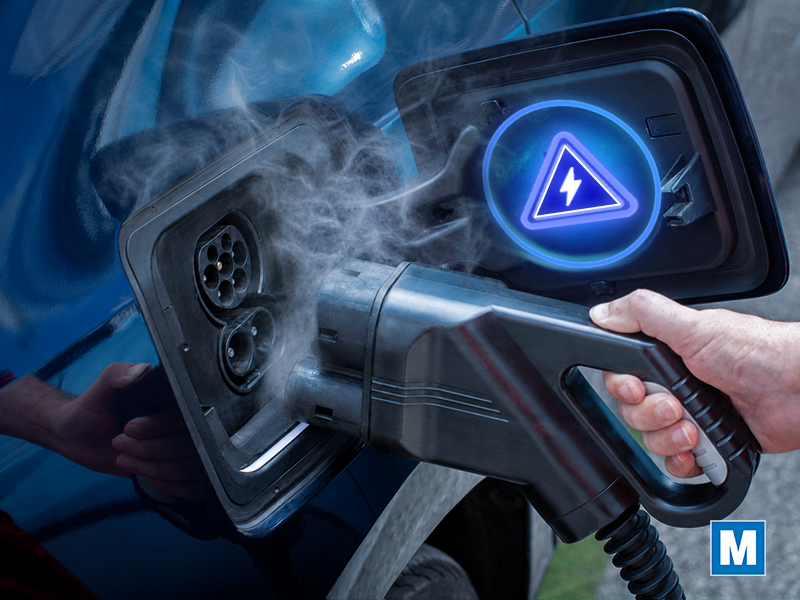
A charging port fault on an EV requires treating the charging port area as a potential source of high-voltage exposure. It’s crucial to acknowledge that before any work begins, regardless whether the fault code that’s triggering the inspection looks minor or not. These types of faults can range from a failed latch and damaged pins to problems with insulation and arcing inside the port, and how severe they are isn’t always obvious from the outside. Getting the diagnostic approach wrong is how shops can end up with incidents or near-misses on their record, and all from a job that no one expected to go sideways.
Key Takeaways
- Treat the charging port area as a potential source of high-voltage exposure from the start, even when the fault code looks minor.
- Faults fall into three groups: mechanical, electrical, and thermal. Thermal faults deserve the most caution.
- Even parked, the path between the port and the HV battery can retain energy, and a manual disconnect may not isolate every part of it.
- Assess and immobilize the HV system first, then test insulation resistance before accessing the port. An abnormal reading means stop.
- If the inlet shows heat damage, melting, or arcing, the diagnosis stops there and the vehicle needs different handling.
- Set expectations with the customer: EV charging diagnostics include safety checks that can’t be skipped.
What a Charging Port Fault Actually Covers
You can classify charging port faults into a few distinct categories, and knowing which one you’re dealing with determines how the diagnosis is going to go:
Mechanical faults
They’re the most straightforward and cover things like a latch that won’t release, a port door that won’t open or close, physical damage to the cable from being yanked on or driven away without being disconnected first.
These problem often look like hardware issues – and often they are – but physical damage to the inlet can compromise the insulation around the high-voltage charging pins in ways that you can’t see without a closer look.
Electrical faults
Electrical faults are a different situation altogether. When you get a communication error fault code, a charging session won’t initiate, or there are BMS codes related to insulation faults, there may actually be damage to HV components or somewhere along the charging cable path.
The technician can’t assume the area is safe in these scenarios, even if the vehicle appears to have powered down and the charge session isn’t running.
Thermal faults
The category of thermal faults deserves the most caution and is quite different than the others. If the power shows signs of heat damage, there’s discoloration around the pins, or there’s a customer complaint about a hot electrical smell, smoke, or burning during charging, there might be situation of high resistance generating heat.
Thermal events inside a charge port have the potential to damage insulation on HV cables in ways that create a hazard during diagnosis that you wouldn’t have when the vehicle is being operated.
Pre-Diagnosis Safety Steps Before Working on Charge Ports
Before starting any work on the charge port area when there’s an active fault, the HV system needs to be assessed and immobilized. The Midtronics xIM-100 EV Immobilizer is exactly the right tool to determine when it’s immobilized and safe to work on. To diagnose the charge port, there are a few considerations that aren’t as relevant on other EV jobs that need to be understood before you get started.
Even with the vehicle parked and before a charge session has begun, the path between the port and the HV battery runs through components that can retain energy. Although the manual disconnect de-energizes he drive circuit, it doesn’t necessarily isolate every part along the charging path on all vehicles. That’s key to know before anyone’s hands go near the inlet.
What complicates things further are insulation issues or thermal damage. If the protection around the HV components in the port area are compromised in any way, the technician is exposed to a different level of risk than a clean pre-work check would give away. Testing the insulation resistance on the HV circuit before accessing the port give a clearer picture of what’s actually happening. An abnormal reading throws up a stop sign that halts work in its tracks – not a proceed-with-caution situation.
Vehicle movement is the third scenario to consider. An EV with a charging system fault could try to re-engage with charging equipment if it senses a connection signal during diagnosis – whether there’s a connection or not. That’s another reason an immobilization tool is so important, preventing the vehicle from responding to charge inputs or even moving on its own power while it’s being worked on.
Working Through the Diagnosis
Once the safety checks are done before work begins and the system has been verified as immobilized, it’s time to look at the fault categories and proceed with the diagnosis.
For mechanical faults, start with a visual inspection for physical damage, pin condition, and debris at the inlet. Check the latch mechanism, the port actuator, and their wiring for damage or corrosion – making sure, of course, that the system is de-energized first. Most latch and actuator faults are low-voltage problems that don’t need access to the HV side of the port at all.
For electrical or communication faults, pulling the fault code history from the vehicle’s charging control module and onboard charger gives you a starting point for where the failure is originating. A fault that’s consistently present suggests a hardware issue in the port itself or in the charge cable path. An intermittent fault that only appears during occasional charge sessions or at certain charge levels points toward a heat, connection integrity, or communication issue that needs to be recreated before it can be properly diagnosed.
For thermal faults, the inlet needs to be visually inspected for heat damage before anything else. If there’s discoloration on the pins, melting on the plastic housing, or evidence of arcing, the diagnosis stops there. That vehicle needs a different handling process before it gets further into a service bay, and the damaged components need to be documented and inspected for HV insulation integrity before any repair work starts.
Frequently Asked Questions
What kinds of charging port faults are there?
Mechanical faults, like a latch that won’t release, a port door that won’t open or close, or cable damage. Electrical faults, like communication errors, charge sessions that won’t start, or BMS insulation codes. And thermal faults, like heat damage, discoloration around the pins, or a burning smell during charging.
Why is a charging port fault a high-voltage safety concern?
Even with the vehicle parked and no charge session running, the path between the port and the HV battery runs through components that can retain energy. Physical damage or insulation problems can also expose the technician to risk in ways that aren’t visible from outside.
What should you do before working on a charge port with an active fault?
Assess and immobilize the HV system first, which is where a tool like the Midtronics xIM-100 EV Immobilizer comes in. Then test insulation resistance on the HV circuit before accessing the port. An abnormal reading is a stop sign, not a proceed-with-caution situation.
Why does immobilization matter for charging port work?
An EV with a charging system fault could try to re-engage with charging equipment if it senses a connection signal, or even move on its own power. An immobilization tool keeps the vehicle from responding to charge inputs or moving while it’s being worked on.
How do you diagnose a thermal fault at the charge port?
Inspect the inlet for heat damage first. If there’s discoloration on the pins, melting on the plastic housing, or evidence of arcing, the diagnosis stops there. The vehicle needs a different handling process, and the damaged components must be documented and inspected for HV insulation integrity before any repair starts.
How should you explain a longer charging diagnosis to the customer?
Set expectations before the work starts. Let them know it’s different from an ICE diagnosis: there are pauses for safety checks, verification steps that can’t be skipped, and steps that may seem unnecessary but can’t be missed. Customers who understand why are much easier to work with than those expecting a 30-minute appointment.
Communication Between Service and the Customer
Problems with a charging port isn’t something that customers are expecting to encounter, and it’s because symptoms don’t usually match what they would expect as the root cause. The car drives fine, everything else works, but it won’t charge or charges intermittently. Sometimes, it’s even related to a specific charging network.
When the diag involves anything beyond a linear mechanical fix, make sure you’re setting clear expectations with the customer before the work starts. Let them know that it’s not the same as an ICE vehicle diagnosis – there are longer pauses for safety checks, there are safety verification processes that can’t be skipped, and there may be steps that seem like a waste of time that absolutely cannot be glossed over or missed. The repair path depends on following the diagnostic process. Customers who understand why EV charging diagnostics take longer than swapping a fuse or clearing codes are much easier to work with than ones who expect a 30-minute appointment.
Ensure they know that your shop is equipped with the right equipment to handle the job from pre-diagnostic verifications through to a completed repair. From testing the integrity of the HV system to figuring out why the charge port door isn’t opening, the customer will be much more understanding of the extended repair timeline when you communicate at each step.
Midtronics EV safety solutions support the work that makes charging port diagnosis safe to perform. If your shop is seeing charging faults and the safety verification side of the process isn’t fully built out yet, that’s the part worth addressing first.