
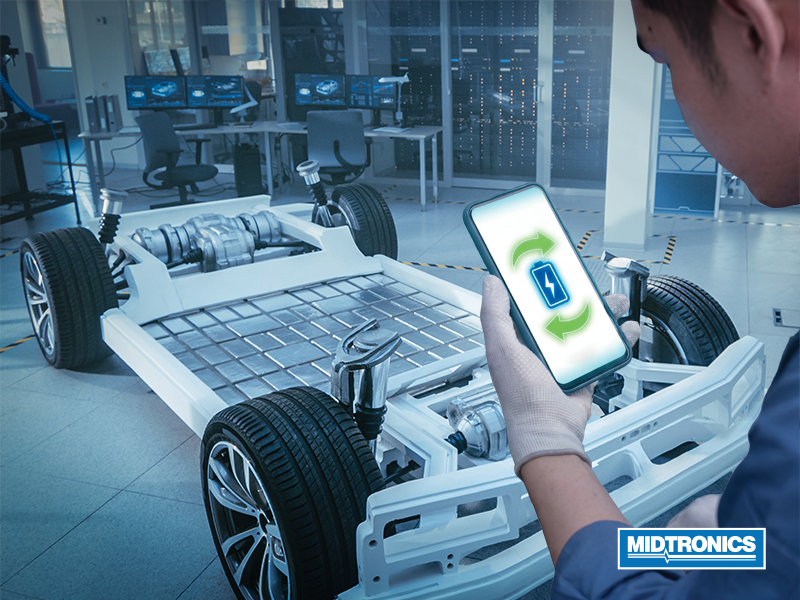
Imagine a future where a buyer is looking at an electric vehicle (EV), and before they even talk price, they ask for a battery report. Up pops the battery’s actual life story: how healthy it is, whether it’s ever been in a wreck, whether any modules have been swapped. No guessing, no “trust me, it’s fine” from the salesperson.
That’s the idea behind the digital battery passport. The rules come from the European Union, and we’re bringing that work to life at Automechanika 2026 with a live demo: scan a battery, watch its condition get read in real time, and see that data land in an actual digital passport right in front of you.
Okay, so what actually is it?
Starting February 2027, most new lithium batteries sold in the EU (e-bikes, electric vehicles, grid storage systems, anything above 2kWh) will need one of these digital passports. It’s not a paper form. It’s a cloud record tied to the battery, accessed by scanning a QR code on the pack or the vehicle itself.
It builds up in layers. At launch, it’s mostly static facts: battery chemistry, who made it, energy storage capacity. Over time it starts picking up dynamic data too, things like state of health, repair history, and eventually something called “state of safety,” which we’ll get to. Basically, it turns into a medical chart for the battery. Something happens to it, it gets logged, and the record follows it for life.
Why this isn’t staying in the EU
There are a few reasons this reaches well beyond the EU institutions that wrote the rule.
The supply chain is global. A big chunk of the world’s battery cells come out of China, and Chinese suppliers need to comply with EU rules if they want to keep selling into the EU market. Once a supplier builds the compliance infrastructure to meet those rules, it tends to show up everywhere else they sell too, because running two separate systems costs more than running one.
The technical details are still being finalized. The regulation itself is already law, but the exact specifications, like which data fields are mandatory and on what timeline, are still being worked out by the European Commission alongside industry consortiums. It’s real law, and real implementation is still catching up to it.
A shop scenario that makes this concrete
Imagine an auto tech running an electric vehicle repair bay. A pack comes in with a bad module. The tech uses an xMB module balancer to confirm the module’s bad, then pulls a fresh one off the shelf and charges it to match the rest of the pack before swapping it in.
Here’s the part that changes under a passport system: the xMB already captured everything needed to log the swap, which module came out, which one went in, and the module’s condition.
Now there’s a bad module sitting on the bench. Before it goes anywhere (recycling, refurbishment, a second-life buyer), a quick technical check tells the shop whether it’s fine to ship on a standard truck or whether it needs to be flagged and handled as higher-risk. That one distinction is the difference between a normal freight rate and an expensive isolated shipment. Right now, most shops don’t have an accurate way to make that call, so everyone defaults to paying for the expensive option just to be safe. A verified passport record fixes that.
What happens after the battery leaves the car?
Here’s a second scenario. A solar farm operator is looking to add battery storage on the cheap, and a broker offers them a stack of used EV packs pulled out of retired electric vehicles. The obvious question: are these actually good enough for this job, or are they scrap?
Right now, that’s mostly a judgment call based on visual inspection. Under a passport system, the battery’s full history travels with it: how it degraded, whether it was ever in an accident, what condition it left the vehicle in. The operator gets a real answer instead of a guess, and the industry gets a much more efficient way to route batteries into the right second life application instead of scrapping ones that still have years left, or reusing ones that shouldn’t be.
“Battery health” and “battery safety” are not the same thing
A battery that passes a diagnostic test isn’t automatically safe for a technician to touch, transport, or dismantle.
State of health (SoH) tracks degradation, how much capacity it’s lost. State of safety (SoS) is a different question entirely: is this specific battery stable enough to handle or transport right now? A battery can have solid overall health (available energy storage capacity) and still have hidden damage that makes it genuinely unsafe to move without precautions.
Turning “is this safe?” into a quantifiable metric that can be consistently measured and rated is a hard problem. It’s not binary. It depends on things like chemical state, isolation integrity, hidden damage like heat exposure, and recalls that haven’t been executed, none of which are obvious from the outside. That’s exactly the kind of question that’s still being worked out, and it’s where Midtronics comes in.
Midtronics is literally in the room where this gets built
Midtronics isn’t just watching this happen. We’re one of 21 organizations in BASE, an EU-funded consortium building the actual technical standards behind the digital battery passport, alongside vehicle manufacturers, recyclers, raw material suppliers, and energy storage companies. We’re one of the key diagnostics and verification companies in the group, and we co-own the pieces of this project focused on rapid battery health assessment and battery safety diagnostics, which means we’re directly involved in figuring out how “state of safety” gets defined and measured in the first place.
Come see Battery Passport in action at the Midtronics Automechanika Booth- Hall 9.0, Booth C65.
Summary
- Digital battery passport: a cloud record for a battery, accessed by QR code, not a physical document.
- Kicks in February 2027 in the EU for batteries above 2 kWh (electric vehicles, e-trucks, e-bikes; not standard 12V batteries).
- Not retroactive, unless a battery gets repurposed or sent to a second life.
- EU relevance: this is already law, and any company manufacturing, importing, or servicing batteries above 2kWh in the EU needs to be building toward it now.
- State of health isn’t state of safety. One tracks aging, the other tracks whether it’s safe right now.
- Midtronics is one of the companies actually building the safety-measurement standard, not just complying with it.