
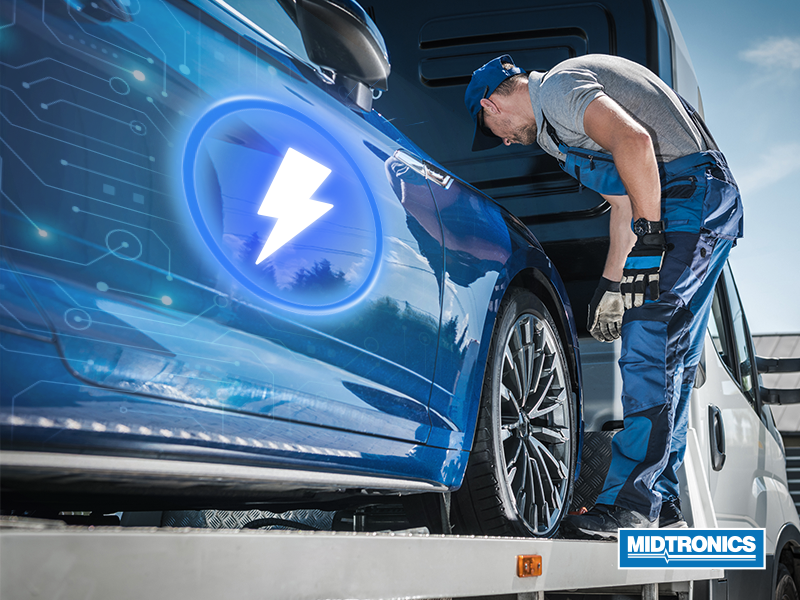
Towing an electric vehicle requires different precautions than an internal combustion engine vehicle, whether you’re moving it across the shop lot or picking it up miles away. An EV that looks to be powered down may still be capable of moving, and improper towing can damage the drive system or create safety risks if the high-voltage battery has been compromised. For shops that handle their own towing, start with assessing the vehicle, preventing unintended movement and enforcing manufacturer safety processes before the EV is moved.
Why EV Towing Requires a Different Approach
For the auto service and repair industry, in-house towing can be a valuable service. A shop can pick up a customer’s disabled vehicle rather than relying on a third-party towing company, and the same equipment can move vehicles on the lot that can’t move under their own power. EVs complicate that familiar process.
A gas-powered vehicle usually provides clear clues about its operating state, but an EV can be completely silent while remaining in a drive-ready condition. Someone using the controls or accidentally pressing the accelerator could potentially cause unexpected movement if the vehicle hasn’t been properly shut down.
There’s also the question of why the EV became disabled in the first place. A vehicle with a dead battery presents differently from one involved in a collision, exposed to flooding or with a suspected high-voltage problem.
Before attempting to move the EV, those using the tow equipment need to know what happened, inspect for obvious damage and consult the manufacturer’s towing or emergency information for that specific vehicle.
Start Every EV Recovery with a Safety Assessment
The safest towing procedure begins before a hook, boom, or winch cable is attached.
Ask the customer or driver what happened when possible:
- Did the vehicle simply stop driving?
- Was there a collision?
- Were there warning messages, smoke, unusual heat, or odors before it stopped?
Then inspect the vehicle from where it’s safe. Collision damage can affect systems that aren’t immediately visible, including the high-voltage battery underneath the vehicle.
Personnel responsible for EV towing should recognize warning signs that signal them to stop rather than continue with a recovery. These can include:
- Smoke, sparks, flames or unusual sounds
- Significant damage near the battery or high-voltage components
- Severe underbody damage or leaking fluids
- Evidence of flooding, fire or a serious collision
- Unusual heat or odors around the battery
A badly damaged EV isn’t simply another tow. Depending on the circumstances, emergency responders or staff with a higher level of high-voltage training may need to get involved.
The same caution should continue after the EV reaches the shop. A potentially damaged battery shouldn’t automatically be considered safe because the vehicle was transported without a problem.
Prevent Unintended Movement Before the EV Is Moved
One of the unusual challenges with EV recovery is determining whether a silent vehicle is actually immobilized. That’s where a tool like the Midtronics xIM-100 EV Immobilizer can add another layer of protection. The xIM-100 connects to the EV’s charge port and signals to the vehicle that it’s plugged in, preventing it from moving with its own motors. The LEDs confirm it’s immobilized.
For a towing employee working beside a disabled vehicle, that visual indicator can be particularly valuable. Instead of relying solely on whether the dash is off or the vehicle is making noise, the employee has another way to see the status.
Because the xIM-100 works at the charge port, they don’t need to access high-voltage components to use it. It also allows functions such as windows, seats and lights to operate, which can be useful when getting it ready to tow.
There’s an important distinction, though. Immobilizing an EV against self-propelled movement isn’t the same as de-energizing its high-voltage system. Technicians still need to follow manufacturer HV safety procedures whenever the work requires them.
Loading and Transporting an EV
Once the vehicle has been assessed and unintended movement has been dealt with, the next question is how it should be transported. This is one area where towing personnel shouldn’t rely on a universal rule. Manufacturers specify how individual models may be transported, which wheels can contact the ground and how the vehicle should be placed into neutral or transport mode.
Many EVs require flatbed towing or certain wheels to remain off the ground. Allowing the driven wheels of some EVs to rotate during towing can damage drive motors and other components or create other problems.
Electronic parking brakes can further complicate recovery. A vehicle with a discharged 12-volt battery, electrical fault or collision damage may not release its parking brake or shift normally into neutral. Trying to drag the vehicle onto a truck instead of following the proper procedure can turn a straightforward recovery into an expensive repair.
Before loading an EV model for the first time, towing personnel should check:
- The manufacturer’s approved towing method
- Which wheels, if any, can be on the ground while moving
- The neutral, tow or transport-mode procedure
- Recovery, winching and tie-down points
- Procedures when the parking brake or drivetrain can’t be released normally
Wheel dollies or other equipment may be necessary when the vehicle can’t roll normally. Most importantly, personnel shouldn’t wing it simply because a particular method worked on another EV model. Procedures can vary significantly between manufacturers and models.
Moving EVs Around the Shop Requires the Same Care
Not every EV tow begins on the roadside. It’s highly likely your shop will routinely move disabled vehicles between parking areas, service bays, charging stations, and storage areas.
Because the distance might only be across the lot, it’s tempting to treat these movements differently. But many of the same questions apply. Can the EV roll safely? Is the parking brake released? Is it actually immobilized? Does the manufacturer permit the wheels to rotate while the vehicle is being moved?
Establishing a repeatable procedure for consistency helps prevent different employees from making different assumptions.
The xIM-100 can provide visual confirmation of propulsion immobilization during these situations as well. That’s especially useful when several employees are involved in moving the vehicle or responsibility passes from towing personnel to a technician.
Build EV Towing into the Shop’s Safety Process
You shouldn’t wait until an EV is stranded on the roadside to decide how employees need to handle one. A written EV towing and recovery procedure gives employees a repeatable process to follow. Training should cover identifying EVs and hybrids, assessing potential battery damage, finding manufacturer towing information, using recovery equipment, and recognizing when a situation exceeds the employee’s training.
The procedure should also include the handoff to shop staff once the EV arrives. The person who recovered it may know about warning messages, collision damage or unusual behavior that the technician needs before beginning diagnosis.
As EVs become more common in repair shops, towing and vehicle movement need to become part of the shop’s overall EV safety strategy rather than being treated as separate activities.
Make EV Safety Start Before the Service Bay
Safe EV service begins before a technician connects diagnostic equipment. It starts when shop staff first get to a disabled vehicle.
For garages that provide in-house towing, that means assessing the EV before moving it, making sure it’s disabled, knowing approved towing procedures, and recognizing when damage requires a different response. The same approach applies when an EV is simply being moved around the lot.
The Midtronics xIM-100 EV Immobilizer provides another way to control that process. Combined with proper training, manufacturer towing information and established high-voltage safety procedures, it can help shops make EV safety part of the entire service process, starting well before the vehicle reaches the lift.
FAQs
- What should shop staff check before moving a disabled EV?
Assess why the EV stopped, look for battery or collision damage, and verify the manufacturer’s towing procedure before moving it.
- How should a shop handle an EV with suspected battery damage?
Stop recovery if there are signs of battery damage, heat, smoke, or unusual odors and follow the appropriate emergency steps.
- Why is unintended movement a concern when recovering an EV?
An EV can remain drive-ready without engine noise, making its operating status less obvious to personnel working around or loading it.
- How can the xIM-100 help when recovering a disabled EV?
The xIM-100 prevents self-propelled movement through the charge-port interface and provides visual confirmation of the vehicle’s immobilization status.
- Does immobilizing an EV mean the high-voltage system is de-energized?
No. Propulsion immobilization doesn’t de-energize the high-voltage system. Technicians must still follow the manufacturer’s required high-voltage safety procedures.