
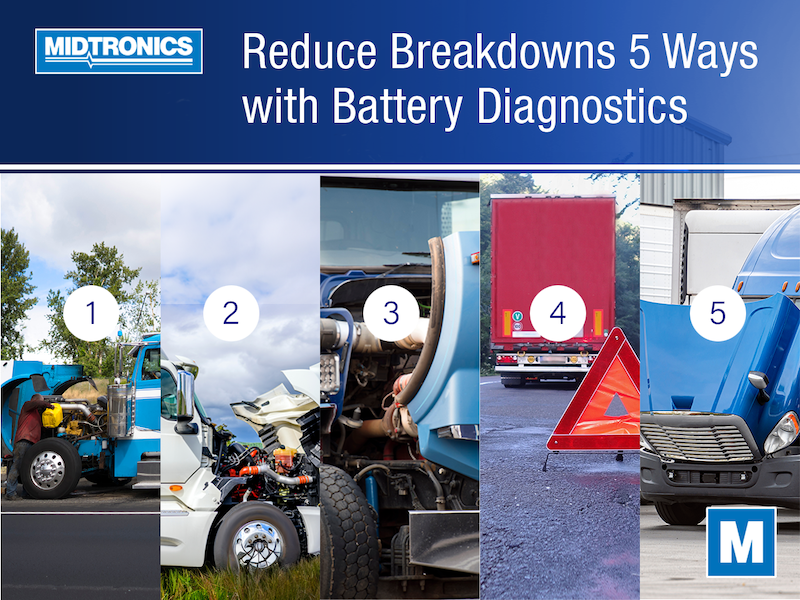
It takes a lot of time and effort to make sure fleet vehicles stay on the road as much as possible. For every day – or even every hour – of downtime, it costs your business. It could be the wages of a long-haul driver who’s sidelined with a dead battery, a rental car that can’t be rented out because it won’t start, or any number of other scenarios.
Key Takeaways
- Battery-related no-starts are the leading cause of unplanned truck breakdowns — and most are preventable with regular testing.
- Fleet managers who implement test-every-vehicle protocols at every PM interval see measurable reductions in roadside battery failures.
- Data-driven battery replacement scheduling eliminates both premature replacement and the costly failures that come from running batteries too long.
- Heavy-duty trucks face more severe battery stress than passenger cars — higher loads, longer idle periods, and more extreme temperatures.
- Onboard battery monitoring systems provide real-time health data, enabling intervention before a battery failure strands a driver.
- The cost of a single roadside breakdown — towing, downtime, driver overtime, missed deliveries — far exceeds the cost of proactive testing.
And it comes with more expenses too. If a breakdown happens away from home base, there are additional repair costs from a shop that doesn’t have negotiated rates, parts costs are higher, and there can be roadside or towing-related charges too.
Cost, inconveniences, and downtime can be avoided for battery issues, though, with these five battery diagnostic processes.
Test Batteries During Every Service Interval
For fleets of all sizes, service intervals are often required at much shorter time intervals than the typical personal vehicle, although it’s due to more idling time on the engine and miles accumulated from more time on the road. Because of the frequency that tire rotations, oil changes, brake replacements, and other routine services are required, battery tests might not be done on each of these visits to the shop.
However, it’s leaving your vehicle at risk of a battery issue. How will you know when a battery test has been performed last, and when should it be done next? Since a battery test as part of preventative maintenance only takes around a minute, there’s no reason not to do it on every service. And because a battery can deteriorate quickly under the harsh conditions many fleet vehicles experience, it’s best to be able to track degradation more often.
Test and Charge Batteries on Idle Vehicles
If a fleet has vehicles that don’t move for weeks at a time – like a trucking company with spare vehicles, or a rental agency with specialty models that aren’t rented often – those batteries could be weak or dead sooner than you imagine. What happens when a driver attempts to start it and go? Not only could you need to send someone to boost or recharge the battery, but the driver now wonders whether it’s going to be fine when they shut it off later.
When a fleet has idle vehicles, ideally anything over a week, the battery should be tested to ensure it has sufficient charge to start and operate normally. If the battery is less than 80% charged, or if the voltage is 12.5 volts or less, apply a trickle charge.
Establish Life Cycle Management Processes
It’s a common process for fleet managers to establish life cycle management processes for engine oil, determining the best interval for getting the most life from expensive synthetic fluids without causing wear or damage to their engines. In a similar fashion, battery life cycle management can be established.
This involves monitoring degradation as well as typical failure time frames and mileages on similar fleet vehicle classes and types. You can begin to get a fairly accurate picture of when certain vehicles will need a new battery installed, and source those parts to have on hand pre-emptively. Not only can it prevent a breakdown by replacing the battery before you get the first no-start condition, but it can help save replacement costs by finding competitively priced options rather than the only one you can get.
Enable Real-Time Battery Monitoring
Many fleet management technologies include battery monitoring. It can range from real-time voltage monitoring to historical data that’s charted for reporting, and this type of monitoring can save your fleet from breakdowns in the field. When you’re able to see the condition of the charging system and the battery’s health for each vehicle in the fleet, you can identify abnormalities before even the driver detects an issue.
If vehicles don’t have battery management technology installed, it can be added after the fact. Then, even between routine services, it’s possible to identify when an issue is arising so it can be handled proactively. Again, it also saves downtime for a truck that would otherwise be losing productivity, as well as the driver’s labor costs while they’re out of commission.
Check EV Battery Safety Power Capacity
Fleet companies worldwide are adopting electric vehicles at an explosive rate, from passenger cars as rentals to heavy trucks that haul cargo. And while the high-voltage battery health needs to be checked from time to time and the battery pack kept fully charged, the 12-volt battery is arguably the component that leads to the highest number of roadside calls for EVs.
This battery, aptly known as an EV’s Safety Power Capacity or SPC, can cause the car to shut off completely, lose power to critical safety functions, trigger diagnostic trouble codes, or contribute to a host of other electrical conditions like preventing the doors from opening. Unfortunately, this battery is often forgotten about by servicing shops.
The 12-volt battery in an EV should be checked as routinely as you would check the battery in an ICE vehicle. Doing so could catch a condition that would leave the driver stranded otherwise, and in the most unsuspecting manner possible.
Conclusion
Fleets of every kind are based on productivity, and each vehicle’s health plays a significant factor in keeping maintenance and repair costs low, efficiency high, and customers satisfied. Battery diagnostics are an avenue for maintaining a fleet that is streamlined, mitigating the occurrences of breakdowns in the field by proactively finding and addressing weak and failing batteries.
Implement these five strategies to maximize your fleet’s productivity, saving costs on unexpected repairs, excessive labor, and keeping your fleet moving on time.
Frequently Asked Questions
What percentage of truck breakdowns are battery-related?
Industry estimates consistently put electrical and battery failures among the top three causes of unplanned commercial truck breakdowns, accounting for 20–30% of roadside incidents. For fleets running heavy electrical loads (refrigerated transport, lift gates, telematics), the percentage can be even higher.
How often should fleet batteries be tested?
Best practice is testing at every preventive maintenance interval — typically every 10,000–15,000 miles or every 3–6 months, whichever comes first. Higher-stress applications (short-haul with frequent starts, extended idling, cold climates) justify more frequent testing. Midtronics commercial vehicle testers make high-volume fleet testing fast and consistent.
What is the ROI on fleet battery testing programs?
A single avoided breakdown saves $500–$2,000+ in towing, driver overtime, and expediting costs, plus the intangible cost of a missed delivery commitment. A comprehensive battery testing program typically costs a fraction of that per vehicle per year. The ROI is compelling — most fleet managers who run the numbers find testing programs pay for themselves with one avoided breakdown per vehicle per year.
Can onboard monitoring replace periodic testing?
Onboard battery monitors provide continuous state-of-charge data, which is valuable for managing charging schedules. However, state of health (actual battery capacity) requires the kind of impedance or conductance-based analysis that dedicated testers provide. The two approaches are complementary, not substitutes.
What’s the best way to manage battery replacement decisions across a large fleet?
Data-driven replacement using conductance test results eliminates guesswork. Rather than replacing batteries on a fixed age schedule (which replaces some too early and others too late), condition-based replacement ensures each battery is replaced when its actual health data indicates it’s approaching end of life. The Midtronics Battery Management System automates this across fleets of any size.
Does cold weather require a different battery management strategy for trucks?
Yes. Cold dramatically reduces available CCA, meaning a battery that passes testing in summer may not deliver enough power for cold-weather starts. Fleet managers in northern climates should test in late fall and consider proactively replacing batteries in the 60–70% health range before winter — the cost of a pre-winter replacement is far lower than a winter breakdown.