
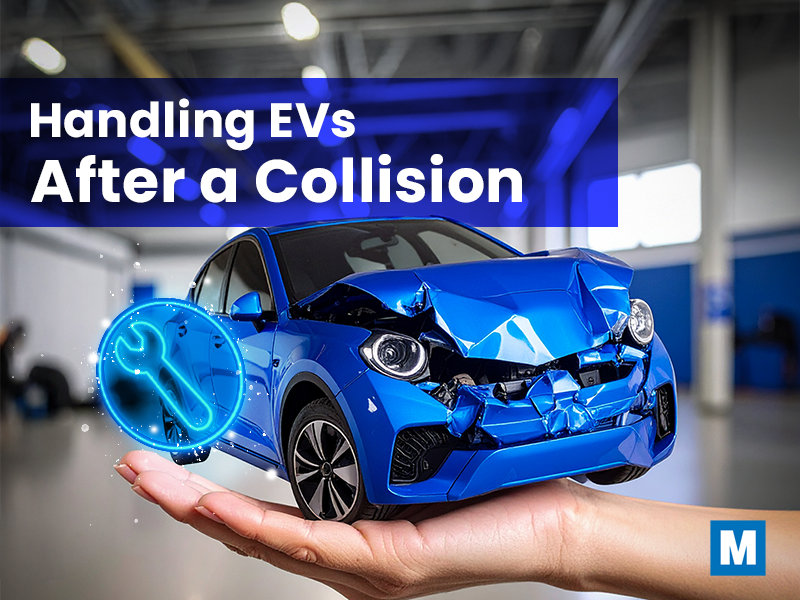
Electric vehicles present new challenges in the collision repair world. Unlike conventional cars, the presence of high-voltage batteries and their electronic systems means everyone involved, from first responders to tow operators, technicians, and insurance adjusters, needs to know what’s involved for safe handling. Missteps can endanger workers, delay repairs, or even worsen damage.
Key Takeaways
- High-voltage batteries can go into thermal runaway hours after a collision, a vehicle that looks safe sitting quietly may still be a serious risk.
- Standard rescue cutting tools cannot be used near orange high-voltage cables without risking electrocution. Emergency responders need to locate the manual service disconnect before extraction begins.
- EVs should be quarantined at least 50 feet from structures after collision until the battery has been inspected and cleared, many insurers and OEMs now require this.
- Tow operators must use flatbed transport for most EVs. Dragging a disabled EV with locked wheels or spinning drive wheels can damage the drivetrain, heating system, and battery pack.
- Battery integrity checks after collision require diagnostic tools that evaluate cell balance and charge acceptance, visual inspection alone cannot detect internal faults.
- Every person in the collision chain (first responders, tow operators, technicians, adjusters) needs EV-specific training. General automotive knowledge is not sufficient.
Let’s outline the key stages of managing an EV after a collision and the responsibilities at each step.
Making the Scene Safe
The first people to deal with a crashed EV are often firefighters, paramedics, or police officers, and their primary responsibility is ensuring the safety of everyone on-site. With EVs, that means stabilizing vehicles and caring for occupants, but it also involves mitigating the risks posed by the high-voltage system.
Responders are trained to identify EVs by markings, badging, or VIN information. Once it’s identified, they secure the scene by disabling ignition systems and looking for potential hazards like leaking coolant, smoke, or sparking. Many EVs have first responder cut loops or clearly marked disconnect points that allow the high-voltage system to be immediately isolated. By pulling these disconnects, responders reduce the chance of battery fires or electrical hazards.
Another crucial step is controlling the surrounding environment. High-voltage batteries compromised in a crash can go into thermal runaway even hours after impact. Fire crews often monitor damaged EVs with thermal imaging and, if necessary, submerge the pack or use suppression agents to ensure the vehicle can be safely released to recovery crews.
Tow and Recovery Protocols
Once the vehicle leaves the crash scene, the responsibility shifts to tow operators. Moving an EV requires special precautions that don’t apply to gas-powered cars. Standard practices like dragging a disabled car onto a flatbed with its wheels locked can actually cause more damage to an EV’s drivetrain or cooling systems.
Tow companies need equipment rated for the vehicle’s weight since EVs tend to be heavier due to the battery pack. Wheel-lift or flatbed towing is recommended, with dollies used if wheels are locked. Operators also need to check for OEM transport info as some EVs require a tow mode activated to protect the transmission or motor assemblies.
Equally important is where the car is stored once transported. If the high-voltage battery has been damaged, it may still pose a delayed fire risk. Many insurers and OEMs now recommend quarantining EVs in outdoor lots at least 50 feet from structures until an inspection clears the battery.
Check for Surface Charge and Initial Safety Steps
When a damaged EV arrives at the shop, the first task is verifying the electrical system’s status. Even if the 12-volt system has been shut down, surface charge can remain in the high-voltage components for several minutes or longer. Technicians need to use insulated tools and protective equipment to measure residual voltage and confirm the system is actually completely de-energized.
Shops should establish intake protocols specific to EVs that could include isolating the vehicle in a designated area, posting warning signs, and restricting access until it’s confirmed safe. Technicians should also visually inspect it for obvious battery damage, coolant leaks, or odors that could indicate some kind of chemical release. Proper documentation at this stage protects both the shop and the customer.
Battery Integrity Checks
After confirming it’s safe, the next step is assessing the condition of the high-voltage battery. A battery pack is the most expensive component in an EV, and damage to even a portion of the pack can have significant financial implications. Getting this right is critical for both repair accuracy and insurance settlements.
Technicians need to evaluate cell balance, charge acceptance, and overall state of health. Diagnostic tools provide data that goes beyond visual inspection, catching internal faults that could lead to failure later. For insurers, this data is invaluable as a pack that appears intact but shows a serious imbalance may not be reliable long-term, and replacement could be justified.
Close collaboration between shop staff and insurance adjusters ensures repair estimates are transparent and accurate. It helps boost customer confidence when diagnostic printouts are shown rather than giving vague explanations. It reduces disputes, accelerates claim approvals, and prevents comebacks months down the road.
Additional Considerations
While high-voltage battery safety takes top priority, collision repair of EVs involves several other unique considerations:
- Cooling systems – EV batteries and drivetrains rely on liquid cooling. Damage to lines or radiators compromises thermal management and must be repaired before the vehicle is safe to operate.
- High-voltage wiring – Cables routed underbody can be pinched, cut, or exposed in a crash. Even if insulation looks intact, resistance testing confirms their integrity.
- ADAS systems – Many EVs come loaded with advanced driver assistance technologies that require recalibration after body repairs.
- Structural repair – EV frames are engineered to protect battery packs in crashes. Technicians need to follow OEM repair guidelines to the letter as improper sectioning or welding can weaken protective structures.
Each of these areas highlights why specialized EV training and equipment are no longer optional in modern shops.
The Role of Training and Communication
Every person in the chain of handling EVs, from first responders to insurers, needs the knowledge to spot risks and the confidence to act appropriately. Ongoing training is of the utmost importance: tow operators should understand manufacturer-specific tow modes, technicians should refresh high-voltage safety certifications, and service advisors should learn to communicate EV-specific issues clearly to customers.
Equally important is communication. Shops should create clear intake forms and customer handouts explaining why additional EV-specific steps are necessary. Being transparent about safety checks and diagnostic processes not only builds trust but also positions the shop as an authority on EV repair.
Turn Risk into Routine
EVs after a collision present more layers of complexity than traditional cars, but with the right process and EV-specific tools, they can be handled safely and efficiently. From the scene of the crash to the final insurance estimate, every stage requires awareness of the 12-volt system, the high-voltage pack, and the cooling and structural systems that keep them stable. Emergency responders, tow operators, technicians, and adjusters all play essential roles in keeping risks contained.
With standardized procedures, proper equipment, and tools from trusted providers like Midtronics, shops can transform EV collision handling from a source of anxiety into a reliable routine. That shift not only ensures safety but also builds long-term customer trust in the electrified automotive world.
Frequently Asked Questions
How long should an EV sit after a collision before work begins?
At minimum 30 minutes under best-case conditions, but that assumes no visible battery enclosure damage. If there’s any sign of battery damage, the protocol extends to 24 hours or more, with the vehicle isolated outdoors away from structures. Some OEM and first responder protocols push that window even further depending on impact severity.
What are the signs of thermal runaway risk after an EV collision?
Smoke, unusual heat from the battery area, popping or cracking sounds, swelling or deformation of the battery enclosure, unusual chemical odors, and coolant leaks from battery cooling lines are all warning signs. The difficulty is that thermal runaway can develop hours after impact with no initial visible symptoms, which is why isolation and monitoring are required regardless of how the vehicle looks.
How does collision damage affect the EV’s ability to safely shut down?
Impact can damage the vehicle’s communication network, knock out control modules, or sever wiring in ways that prevent the shutdown sequence from completing. A vehicle that appears powered down may still have an energized high-voltage system. Always verify de-energization with a properly rated CAT III or CAT IV voltmeter rather than relying on the vehicle’s visual indicators.
What’s the right way to tow an EV after a collision?
Flatbed transport with all four wheels off the ground is the safest option for most EVs. Use wheel straps rather than chassis hooks where possible. Check for OEM tow mode requirements, some EVs require activating a specific transport mode to protect the brake system and drivetrain. Dragging with locked wheels or allowing drive wheels to spin freely can damage the motor, inverter, or battery pack.
Why do collision shops need EV-specific intake protocols?
Standard vehicle intake assumes the car is electrically safe to approach and work on. That assumption doesn’t hold for a collision-damaged EV until the high-voltage system is verified de-energized, the battery enclosure is inspected for damage, and any thermal risk has been assessed. A written intake checklist specific to EVs protects technicians, limits liability, and creates documentation useful for insurance claims.
What does battery integrity testing look like after a collision?
It goes beyond visual inspection. Technicians evaluate cell balance, charge acceptance, and overall state of health using diagnostic tools that can detect internal faults that aren’t visible externally. A pack that appears intact but shows significant cell imbalance may not be reliable long-term, and the diagnostic data is critical for supporting insurance replacement claims. EV diagnostic tools built for collision workflows provide the data both shops and adjusters need.