
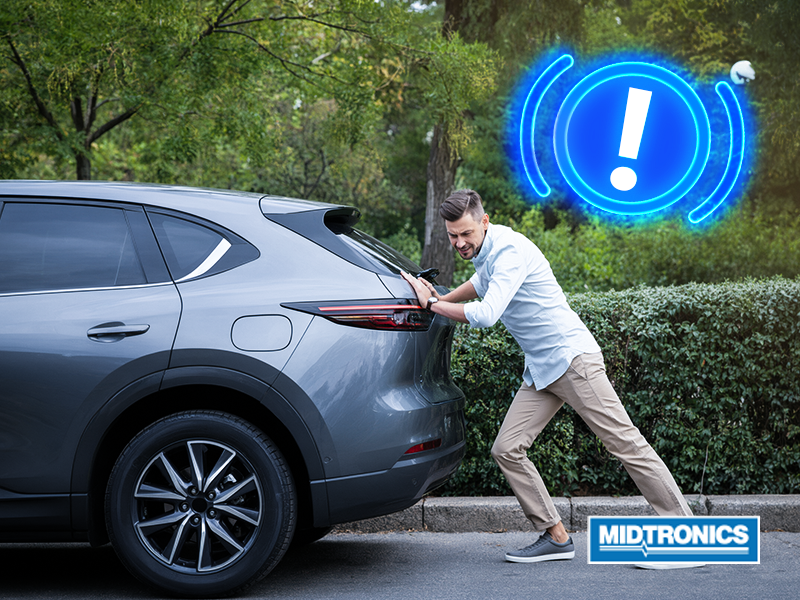
Moving a disabled EV around a repair shop isn’t always as simple as putting it in Neutral and pushing it into a bay. The vehicle could have a dead 12-volt battery, a parking brake engaged, motor damage, or a high-voltage fault that changes how it should be handled. Before moving it, technicians need to know why the EV is disabled, whether it can roll safely, and what the manufacturer specifies for recovery. A few minutes spent figuring that out can prevent vehicle damage and a much bigger problem in the shop.
Start With Why the EV Is Disabled
A disabled EV can mean a lot of things. Maybe the 12-volt battery is dead and the vehicle won’t wake up, or it could have been dropped off after a collision. There may be a charging fault, damaged suspension, a high-voltage warning, or simply a vehicle that refuses to shift out of Park. Those situations shouldn’t automatically get the same response.
Still, it needs to get into the shop bay to be worked on, whether to access tools, charging, or just a more comfortable environment to work on the car. Or, it might need to be moved outside while the parts are ordered or there’s a customer approval for the repair.
Before trying to move the vehicle, look at what brought it to the shop and its current condition. Collision damage, fluid leakage, heat, smoke, popping or hissing sounds, and an odor deserve attention before anyone starts worrying about getting the EV into Bay 3. If there’s reason to suspect high-voltage battery damage, follow the OEM procedures for the vehicle and the shop’s EV safety protocols. Moving it quickly because another vehicle is waiting for the space isn’t worth creating another problem.
Don’t Assume Neutral Is Easy to Find
On an older ICE vehicle, moving a disabled car might have been a fairly familiar routine: release the parking brake, get the transmission into Neutral, and push. Modern EVs can make that considerably more complicated.
Electronic shifters and parking brakes need low-voltage power. Some vehicles have specific tow, transport, car wash, or neutral modes, while others have mechanical or electronic procedures for releasing Park when the normal controls aren’t available. If the 12-volt system is dead, the gearshift may do nothing at all.
This is where guessing gets expensive. Dragging an EV with locked drive wheels can damage tires, drivetrain components, or other systems. Check the manufacturer’s procedure for that vehicle rather than assuming the method that worked on the last EV will work on this one.
Check the 12-Volt System
When an EV appears completely dead, the problem isn’t necessarily the high-voltage battery. The 12-volt system is responsible for waking control modules and supporting many of the functions needed before the vehicle can be moved normally. A low or failed 12-volt battery may leave the doors, electronic shifter, parking brake, and other controls inoperative, so testing the low-voltage battery can quickly give the technician some direction.
If a 12-volt ‘jump start’ is something the manufacturer permits, it may restore enough power to access the proper transport or neutral mode. That doesn’t mean the battery should automatically be replaced. Once the immediate situation is under control, the battery still needs to be tested to find out why it was discharged. A dead 12-volt battery could be the cause of the problem, but it could just as easily be the result of another issue.
Use the Right Equipment for a Vehicle That Won’t Roll
Sometimes the EV just isn’t going to roll normally. A damaged wheel or suspension component may prevent it, the parking brake may not release, or the vehicle may not have Neutral mode accessible under its current conditions. That’s when the shop needs another plan rather than trying to overpower whatever is keeping the vehicle in place.
Wheel dollies may allow a disabled vehicle to be moved without forcing locked wheels to turn. If the vehicle arrived on a flatbed, unloading it should follow the manufacturer-specific recommendations too. The objective is to move the EV without turning the original problem into drivetrain, body, or battery damage.
Moving an EV Around the Lot Has Its Own Risks
Not every hard-to-move EV involves a completely dead vehicle. An EV may still be capable of propulsion but need to be moved while it’s being diagnosed or repaired. In that situation, technicians need to know whether it can move under its own power, especially when several people are working around it.
EVs don’t give the same cues as an idling ICE vehicle. No engine noise doesn’t mean the vehicle is off or immobilized, and that becomes especially important during service involving the wheels, suspension, underbody, or high-voltage components.
The Midtronics xIM-100 addresses this problem by connecting through the EV’s charge port and providing a clear visual indication of its mobility status. When it’s connected, it helps technicians identify that the vehicle is immobilized and can’t move on its own. That can be useful in a busy shop where several technicians may interact with the same vehicle during the day.
However, immobilized doesn’t mean electrically safe for high-voltage service. The xIM-100 doesn’t replace OEM high-voltage shutdown procedures, PPE, or verification that high voltage has been isolated. Mobility status and high-voltage status answer two different safety questions.
Have a Plan Before the EV Blocks the Shop
A disabled vehicle has a way of ending up exactly where nobody wants it. It gets dropped in front of a service door, stops halfway into a bay, or arrives on a tow truck during the morning rush. That’s not the ideal time to invent a procedure.
Shops servicing EVs should already know where disabled or potentially damaged vehicles can be placed, what moving equipment is available, and who is qualified to make decisions when high-voltage damage is suspected. Technicians should also have access to OEM recovery information instead of relying on memory. Even a basic plan can make these oddball situations much easier to handle.
And once you know that it can’t be driven, make it clear to everyone who could get into it. Add a flashy sign on the steering wheel and the keychain, and hang a warning on the rearview mirror. Be as clear as possible when a vehicle shouldn’t be moved, or even attempted to be driven.
Move It Safely, Then Diagnose Why It Stopped
Getting a disabled EV into the bay solves the immediate logistical problem, but it doesn’t explain why the vehicle became disabled. Once it’s positioned safely, the diagnosis can move on to the 12-volt system, high-voltage system, charging faults, drivetrain concerns, or whatever brought the vehicle in.
Tools such as the Midtronics xIM-100 provide clear mobility status indication while technicians work around an EV. The important part is not treating every disabled EV the same. Figure out what condition the vehicle is in first, use the right procedure to move it, and then get to the reason it stopped.
FAQs/People Also Ask
- Can you push a disabled EV?
Sometimes. The vehicle must be able to enter Neutral or transport mode, and the manufacturer’s procedure should be followed.
- What if an EV won’t shift out of Park?
Check the 12-volt system and the OEM procedure for releasing Park or entering a transport mode. Don’t force the vehicle to move.
- Can a dead 12-volt battery keep an EV from moving?
Yes. Low-voltage power supports many control systems, including functions that may be required to release or move the vehicle.
- Can wheel dollies be used to move a disabled EV?
They may be appropriate when wheels can’t roll normally, but follow the vehicle manufacturer’s recovery and lifting guidance.
- Does an EV need to make noise to be capable of moving?
No. An EV can be capable of propulsion while making little or no sound, so noise isn’t a reliable indication of mobility status.
- Does immobilizing an EV make it safe for high-voltage repairs?
No. Immobilization addresses vehicle movement. High-voltage service requires separate OEM safety, isolation, and verification procedures.