
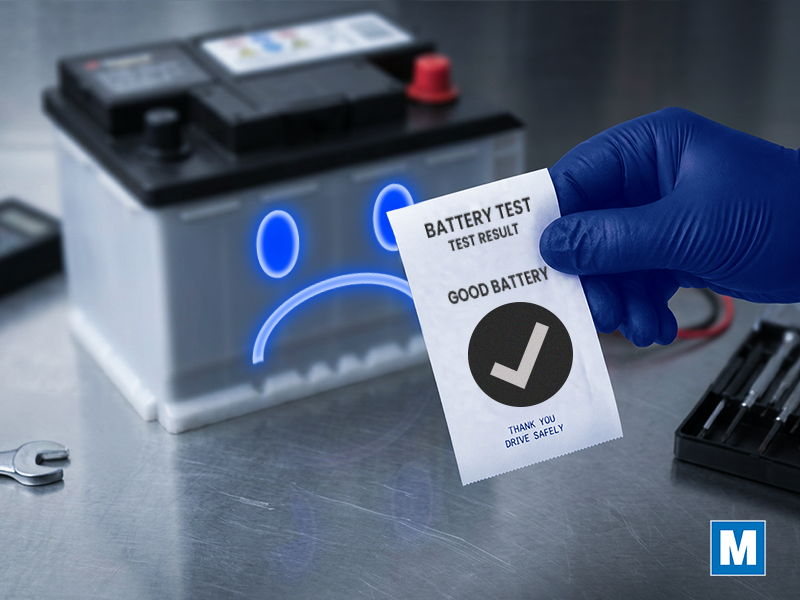
A battery tester may return a decision, but that doesn’t always mean the diagnosis is finished. Battery condition, state of charge, temperature, recent charging, test inputs, and even where the tester is connected can influence the result. When a battery test doesn’t match the vehicle’s symptoms, technicians need to look beyond “good” or “replace” and consider the conditions that produced the reading. Understanding misleading battery test results can prevent unnecessary replacements, missed failures, and repeat visits.
Why Can a Battery Test Give a Misleading Result?
Modern battery diagnostic equipment can provide technicians with an accurate assessment quickly, but the tester still needs good information and the right test conditions. A result is only one piece of the diagnostic picture. If the technician enters the wrong battery rating, selects the wrong chemistry, or tests a battery immediately after it’s been charged, the information provided to the tester might not fully represent the battery in question.
There’s also an important distinction between state of charge (SOC) and state of health (SOH). A battery can be fully charged but no longer have the capacity or cranking capability it had when it was new. On the other hand, a healthy battery can be discharged enough that its initial test result raises concerns.
That’s why voltage alone doesn’t provide a complete battery diagnosis. Testing evaluates additional characteristics, including conductance and starting capability, to determine how well the battery can actually perform its job.
When a “Good Battery” Result Doesn’t Match the Symptoms
One of the more confusing situations for a technician is a battery that passes the test even though the customer reports slow cranking, intermittent starting issues, or other electrical symptoms.
Before ruling out the battery, look at the conditions under which it was tested.
Surface charge is one potential source of confusion. A battery that’s recently been charged, jump-started or operated may temporarily show a higher voltage. Testing without taking it into account can make the battery appear stronger than expected.
Incorrect test inputs can also produce a result that doesn’t match vehicle performance. The tester needs to know what it’s evaluating. Entering a lower CCA rating than the battery is actually rated for, for example, changes the benchmark it’s being compared to.
Battery chemistry matters too. Flooded lead-acid, AGM, and other battery designs don’t behave the same. Selecting the correct battery type helps the tester apply the right criteria.
The connection point deserves attention as well. Whenever the equipment calls for testing directly at the battery posts, remote terminals, cables, and connections between the tester and battery can vary conditions that wouldn’t exist if you’re testing at the posts themselves.
When a battery passes but the symptoms remain, don’t automatically assume the test was wrong. Instead, ask whether the test accurately represented the battery and whether another part of the starting or charging system could explain the complaint.
Why a “Replace Battery” Result Can Also Need Context
A failed test can seem much more definitive. If the tester says to replace the battery, the natural next step is replacement, but the circumstances still matter.
A deeply discharged battery is a good example. Low state of charge affects the information available during diagnosis, and the proper next step may be charging and retesting according to the tester’s recommended procedure rather than immediately condemning the battery.
Temperature is another important variable. Battery performance changes considerably with temperature, especially in the cold. Equipment can compensate for temperature, but the tester needs an accurate snapshot of the battery’s temperature.
This becomes especially important with borderline batteries. A battery near the end of its useful service life may perform well enough in mild temperatures but struggle when mercury drops and starting demand increases.
Technicians should treat temperature in context rather than simply another number on the test result.
The Most Common Reasons Battery Test Results Don’t Add Up
When a battery test conflicts with vehicle symptoms or another recent result, it’s worth checking the fundamentals before assuming either the tester or battery is behaving unpredictably. Common causes include:
- Incorrect battery type or chemistry selected on the tester
- Incorrect CCA or other battery rating entered
- Surface charge from recent charging or vehicle operation
- Low state of charge
- Battery temperature that isn’t accurately entered
- Poor tester connections or testing from the wrong location
- Corroded, loose, or high-resistance battery connections
- A starter, charging-system, or parasitic-draw problem being mistaken for a battery failure
Looking at these variables step-by-step is more useful than simply running the same test repeatedly until a different answer appears.
Why Repeated Battery Tests Can Produce Different Results
It’s tempting to retest a battery immediately when the first result doesn’t look right. Then, if the second result differs, run it a third time. That can create more confusion rather than less.
Testing affects the battery. Depending on the method and battery condition, consecutive tests can occur under slightly different internal conditions. The battery may also be recovering from a previous load, charging event, or start.
If the first test was performed correctly, repeating it immediately just to see whether the decision changes isn’t necessarily a better diagnostic strategy.
A retest makes more sense when something about the original test conditions has been corrected. Maybe the wrong battery rating was entered. Perhaps poor terminal contact was discovered, the battery needed to be charged, or a surface-charge condition needed to be addressed.
In those cases, the technician isn’t simply repeating the test. They’re performing a new test under new conditions.
What If the Battery Tests Good but the Vehicle Still Won’t Start?
Starting performance depends on the battery, starter, cables, connections, and electrical systems working together. A battery can be capable of supplying sufficient current while high resistance in a cable or connection prevents that current from reaching the starter as it should. A starter drawing excessive current can create symptoms that initially look like a weak battery.
The charging system matters just as much. If the alternator isn’t charging the battery properly, a healthy battery can go flat time after time. Replacing that battery might temporarily restore normal operation without addressing the reason it lost charge in the first place.
Parasitic draw creates a similar situation. The battery may test well immediately after charging yet repeatedly go dead after the vehicle sits.
When symptoms and battery results don’t agree, cast the net wider. The discrepancy itself is useful information.
How to Get More Reliable Battery Test Results
Consistency starts with a repeatable testing process. Rather than interpreting each battery in a vacuum, establish a standard procedure that technicians follow on every vehicle. A strong process includes:
- Confirming battery type and rating from the battery label
- Inspecting battery posts, terminals, and cables before testing
- Accounting for recent charging, jump-starting, or vehicle use
- Testing at the correct location
- Accurately accounting for battery temperature
- Following charge-and-retest instructions when indicated
- Expanding into starting and charging system diagnostics when symptoms don’t match the decision
Documenting the result adds another layer of value. A battery that passes today may still show deterioration compared with a previous visit. Tracking test history can reveal a trend that isn’t obvious from a single pass/fail decision.
That history also gives service advisors better information to share with customers. Instead of saying that a battery “seems weak,” the advisor can explain how its results have changed between visits and what that could mean as temperatures or operating conditions change.
Look Beyond Pass or Fail
The goal of battery testing isn’t to produce a particular result, nor is it just to sell more batteries. It’s to accurately identify the battery’s condition and determine whether it’s responsible for the customer’s concern.
A “good” result shouldn’t override glaring symptoms without further checks, and a failed result shouldn’t be looked at without also considering state of charge, temperature, and test conditions. The best diagnosis comes from combining accurate test data with proper procedure and an understanding of the complete starting and charging system.
For service departments, that means fewer unnecessary battery replacements, fewer missed problems, and greater confidence when technicians make a recommendation to the customer.
With the right equipment and a disciplined diagnostic process, technicians can move beyond a simple voltage check or pass/fail decision and make battery service recommendations backed by meaningful data. Midtronics battery diagnostic solutions are designed to provide technicians with accurate information about battery condition while supporting consistent testing procedures throughout the service lane.
Frequently Asked Questions
- What is surface charge and how does it affect battery test results?
Surface charge is a temporary voltage elevation that occurs immediately after a battery has been charged. It makes the battery appear at a higher state of charge than it actually is, and can cause a conductance test to read higher than the battery’s true resting condition. To get an accurate result, either let the battery rest for several hours after charging or use a tester that includes a surface charge removal step.
- Does temperature affect battery test results?
Yes. Cold batteries have higher internal resistance and test weaker than they truly are. A battery at 30°F may test marginal when it would test good at 70°F. Most professional testers apply temperature compensation, but extreme cold can still skew results. Test at or note the battery temperature when borderline results need to be interpreted.
- What happens if you test an AGM battery with flooded settings?
AGM batteries have different conductance characteristics than flooded batteries. Testing an AGM with flooded settings will typically produce a lower conductance reading — potentially flagging a healthy AGM as marginal or failed. Always confirm the battery chemistry before testing and enter the correct type in the tester.
- Can a battery test good but still be the problem?
Yes. If the surface charge wasn’t removed before testing, or if the battery was recently charged, the result may not reflect its resting state. Also, some failure modes — like a weak cell — may not be fully captured by a single conductance test. If symptoms persist despite a passing test, repeat testing after the battery has rested overnight and compare with a load test.
- Why should alternator and starter tests be included?
Battery problems often look like alternator problems and vice versa. An undercharging alternator keeps the battery in a chronic partial-charge state, which causes premature failure — but the battery tests marginal, not the alternator. A full system test sequence like those from the DSS-5000 identifies whether the battery, alternator, or starter is the root cause.
- What’s the most reliable way to confirm a battery needs replacement?
Test after proper rest (no recent charging), at a moderate temperature, with the correct battery type selected, using a conductance tester. If the result is marginal or failed under those conditions, replacement is warranted. If borderline, pair the conductance result with a load test for confirmation. Document and print results to back the recommendation.