
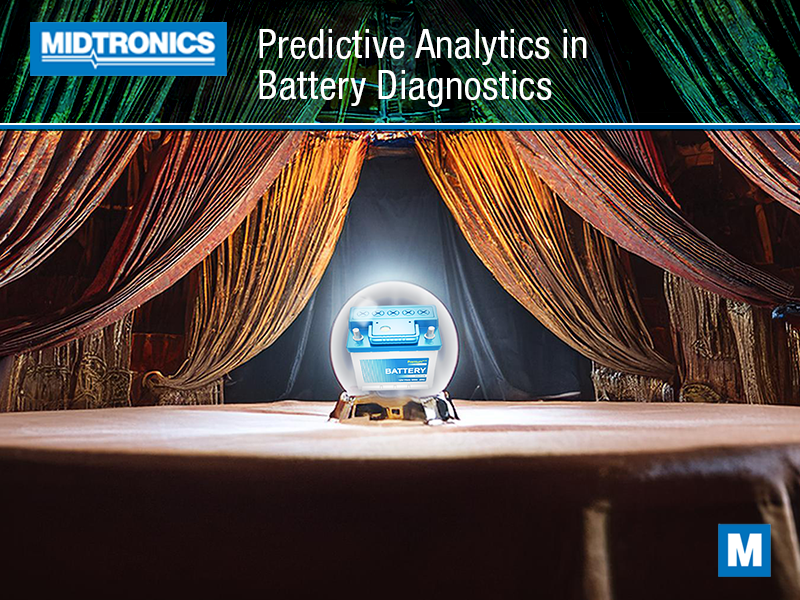
In the automotive industry, the ability to anticipate and mitigate potential failures before they occur is not just a competitive advantage – it’s a necessity. Predictive analytics is at the forefront of this revolution, transforming the way we approach battery diagnostics. By leveraging data, algorithms, and machine learning techniques, predictive analytics enables us to foresee potential issues and optimize battery performance, ensuring reliability and efficiency. Here we explore how predictive analytics works in battery diagnostics and the benefits it offers.
Key Takeaways
- Predictive analytics uses historical test data and usage patterns to flag batteries likely to fail before they actually do.
- Fleet operators and high-volume shops gain the most from predictive approaches — proactive replacements prevent costly roadside failures.
- Midtronics testers generate the conductance and charge data that feeds predictive battery health models.
- Combining tester data with cloud platforms enables shops to track battery health trends across an entire customer base.
How Predictive Analytics Works in Battery Diagnostics
Predictive analytics begins with the fundamental step of data collection. In the context of battery diagnostics, vast amounts of data are generated from various sources, including:
- Voltage levels. Continuous monitoring of battery voltage provides insights into the battery’s state of charge and overall health.
- Charge cycles. Tracking the number of charge and discharge cycles a battery undergoes helps in assessing its remaining useful life (RUL).
- Temperature readings. Temperature fluctuations can significantly impact battery performance. Data on operating temperatures is crucial for understanding the conditions that may accelerate degradation.
- Use patterns. Information on how a vehicle is driven, including load demands and driving conditions, is essential for contextualizing battery performance data.
These data points are typically collected by sensors in vehicles, battery management systems, and diagnostic tools used during maintenance checks. The more data collected, the better the results. Once it’s decluttered and cleaned, it’s ready to be used.
The heart of predictive analytics lies in the development of machine learning models that can identify patterns in historical data and correlate them with battery health outcomes. Some of the common techniques used include:
- Predicting outcomes like the remaining life of a battery based on various input variables.
- A model that makes decisions based on the data, useful for classifying battery conditions.
- Identifying patterns and relationships within the data.
Models are trained on historical data, enabling them to recognize the signatures of potential issues such as capacity fade, internal resistance increase, or imminent failure.
Although it’s different in developing battery diagnostic and testing equipment, the seemingly foreign and revolutionary idea of predictive analytics has been in place for some time in the automotive industry. Some car makes have been using battery management systems for more than a decade in mainstream models, and it’s the same basis used for data collection, albeit for slightly different applications.
Benefits of Predictive Analytics in Battery Diagnostics
One of the most significant advantages of predictive analytics in battery diagnostics is the early detection of potential issues. By analyzing trends and patterns, predictive models can identify subtle signs of deterioration long before they become a noticeable problem. This early warning system allows for:
- Proactive battery replacement before it escalates into a failure that could leave a vehicle stranded.
- Minimized downtime when it’s convenient, avoiding unexpected disruptions.
While it’s important for private vehicles, for fleet operators, early detection translates into fewer emergency repairs and a more reliable operation, which is critical in industries where uptime is paramount.
More Focused Repairs
Traditional maintenance schedules are often based on fixed intervals, which can lead to both unnecessary replacements and overlooked issues. The approximate three-to-five-year battery lifespan doesn’t have to be a timeline for replacement with proper testing. Predictive analytics enables you to be more precise by using data to indicate early stages of when a battery is likely to fail.
Batteries are replaced only when necessary, extending their useful life and reducing waste. What’s often overlooked as well is that maintenance and repairs are focused where they are needed most, helping customers keep vehicles in better shape overall. For service shops, this means better customer satisfaction.
Improved Battery Life
Predictive analytics doesn’t just prevent failures – it can also help extend the overall life of batteries. A decision of “Good Battery – Recharge” on a battery test can point toward a potential vehicle issue that’s causing low battery voltage, perhaps a poorly functioning alternator. It can be repaired before there’s lasting capacity loss to the battery itself.
Cost Savings
The combination of early issue detection, focusing on more pressing repairs, and improved battery life culminates in significant cost savings. Emergency repair costs are minimized, there are fewer battery replacements in the vehicle’s life, and there’s less downtime.
For fleet operators and service shops, these cost savings directly impact the bottom line, making predictive analytics not just a technological advancement but a financial strategy as well.
Implementation Challenges
While the benefits of predictive analytics in battery diagnostics are clear, implementing these systems is not without challenges. As a shop or fleet, the major hurdle comes from figuring out how to establish the data collection, parsing, and results so that it can affect real-world operations.
Which data is correct to use, and which outliers should be ignored? Should all batteries use the same criteria for analytics? It’s a complicated and data-intensive process to undertake.
Rather than trying to come up with a solution, Midtronics battery testing and diagnostic equipment is the right choice. New models incorporate machine learning and predictive analytics to produce the most accurate results of any battery test equipment to date.
Conclusion
Predictive analytics is playing an increasingly critical role in battery diagnostics, offering substantial benefits in terms of reliability, cost savings, and efficiency. By using equipment that uses advanced data and machine learning, automotive professionals can anticipate battery issues before they occur, optimize maintenance schedules, and extend battery life.
As technology continues to evolve, the integration of predictive analytics in battery diagnostics is poised to become an industry standard, driving advancements in automotive maintenance and service. For Midtronics, adopting predictive analytics is not just about staying ahead of the competition – it’s about ensuring the long-term reliability and efficiency of the vehicles that keep our world moving.
Frequently Asked Questions
What is predictive analytics in the context of battery diagnostics?
Predictive analytics applies statistical models to battery test data — conductance readings, voltage trends, charge behavior, and usage history — to calculate the probability that a battery will fail within a given timeframe. Rather than reacting to a dead battery, shops and fleet managers can replace batteries before the failure occurs.
How is predictive battery diagnostics different from standard testing?
Standard testing gives you a snapshot: the battery passes or fails at this moment. Predictive diagnostics tracks trends over multiple tests — a battery whose conductance drops 10% every three months is heading toward failure on a predictable schedule, even if today’s test result is “good.”
What data do predictive models need to work?
Effective models rely on conductance readings over time, cold cranking amp estimates, charge acceptance rates, vehicle mileage and age, geographic/climate data, and in some cases driving cycle information. The more historical test points available per battery, the more accurate the failure prediction.
Which businesses benefit most from predictive battery diagnostics?
Fleet operators benefit most — every unexpected breakdown has a hard cost in towing, labor, and downtime. High-volume service shops, dealerships, and roadside assistance providers also gain significantly. For consumer-facing shops, predictive tools help identify and proactively recommend replacements to customers during routine service visits.
Can predictive analytics reduce battery-related warranty claims?
Yes. Many warranty claims occur because a battery that was borderline at the last service visit failed shortly after. Predictive models catch these marginal batteries before warranty expiration, allowing proactive replacement that prevents the claim entirely and improves customer satisfaction.
How do Midtronics tools support predictive battery diagnostics?
Midtronics testers generate precise conductance and CCA data that integrates with fleet management platforms and cloud-based DMS solutions. This data feeds trend analysis tools that help shops and fleet managers track battery health over time and schedule replacements at the optimal point — before failure, but not prematurely.