
Key Takeaways
- Most battery failures don’t happen suddenly — warning signs like slow cranking, dimming lights, and frequent jump starts signal a battery nearing the end of its life.
- Heat is the leading cause of battery failure, accelerating internal corrosion and water loss even in batteries that appear healthy.
- Parasitic drain from vehicle electronics can kill a battery that’s left sitting for as little as two to three weeks without being driven.
- A battery can test at full voltage and still fail under load — conductance testing reveals internal capacity that voltage alone can’t detect.
- Corrosion on battery terminals increases resistance, causing symptoms that mimic a weak battery even when the battery itself is fine.
- Professional testing at every service visit is the only reliable way to catch battery problems before they leave a customer stranded.
With normal use, most car batteries can last for three to five years without noticeable deterioration. For some styles like AGM and EFB batteries, that can be stretched for six years or so. Regardless of the type of lead acid battery you’re dealing with, it’s only a matter of time until signs of failure start to show up. And if usage is not within the realm of what battery manufacturers consider normal, you could find that failure or symptoms of an unreliable battery can be much sooner.
Among lead acid varieties, signs of failed batteries typically show up as slow cranking or flickering lights, or an inability to turn the engine over. On some models, a Check Engine light with low voltage codes could pop on. But while it indicates a bad or discharged battery, what it doesn’t tell you is what the root cause of the problem is or how you could have prevented it.
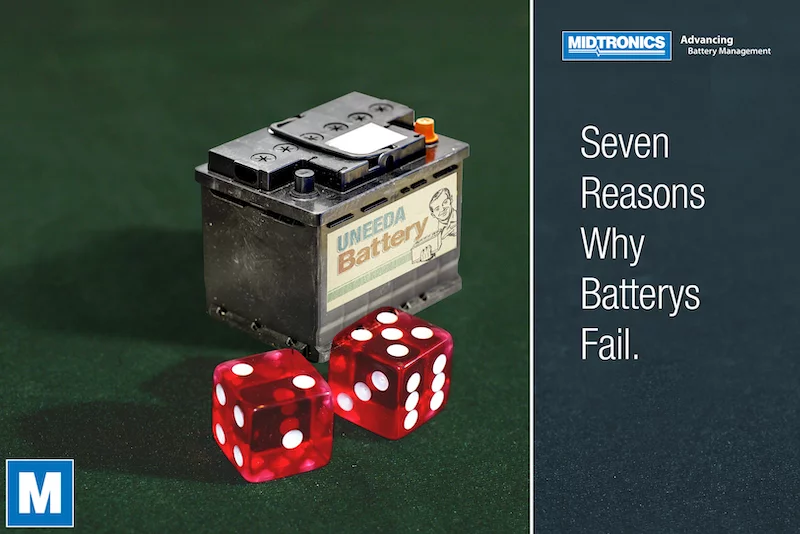
Here are seven causes of car battery failure that you might encounter and how to address each one.
Decreased battery capacity
If the vehicle is driven regularly in normal conditions where the battery fully recharges during trips, it’s still going to fail eventually. The alternator needs to recharge the battery slowly enough to prevent overcharging which can result in the electrolyte converting to hydrogen and oxygen that can be vented. But it also needs to charge quickly enough to bring the state of charge back to 100% or lead sulphate can crystallize on the plates and cause permanent loss of capacity.
Operating your car normally is not enough to prevent decreased battery capacity alone since the charging system isn’t smart enough on its own. When you have the opportunity, a smart charger on your battery overnight can ensure the battery is fully charged, and it can sometimes condition the battery to reverse crystallization.
Sulfation
When a battery isn’t fully charged and crystallization occurs on the plates, it’s a process known as sulfation. However, sulfation occurs to a much more significant level when a battery is allowed to fully discharge, and it gets even worse when it is stored with no charge. Large crystals form on the negative plates that reduce the surface area of a battery’s active material.
Soft sulfation can often be reversed by overcharging the battery for around 24 hours to dissolve the crystals, but hard sulfation is permanent damage. Fortunately, hard sulfation usually occurs after several weeks or more of staying at a low charge, so there’s time for corrective action.
Broken plates from vibration
Not all vehicles have the relatively ordinary life of driving on the highway or city streets all the time. For vehicles with lead-acid batteries that are put through the harshest environments you can imagine like rock crawling, off-roading, and travel on logging roads or badly rutted gravel washboard, vibrations can damage the plates inside. Altogether, an SLA battery appears extremely durable but the electrical connections and plates inside the battery are rather brittle. Constant shaking, impact, or vibration can jostle these connections or plates and cause a break, disrupting the conductivity and immediately rendering it ineffective.
You can’t correct a battery with broken internal plates, but some battery designs are less susceptible to damage in these harsh conditions. Consider a spiral cell or AGM battery to prevent getting left in the dirt.
Battery case is damaged
The case on a car battery is commonly polypropylene resin that’s impact resistant, but not damage-proof. It can warp or crack if the conditions are right, and the result is either internal damage or leaking electrolyte. Swelling occurs when the battery is overcharged or when the electrolyte freezes and expands inside. It can cause leaks at the seams or around the posts, or the case can crack.
Avoid overcharging the battery for extended periods of time, and never store a discharged battery in freezing temperatures. Once the case is damaged, the only correction is replacement.
Corrosion on the terminals
During battery use, the chemical reactions inside separate a small amount of the hydrogen and oxygen out of the electrolyte material. If the hydrogen escapes into the environment, it promotes a corrosive environment. A natural seam where hydrogen escapes is around the battery posts and corrosion forms on the terminals.
However, where the corrosion is exhibited primarily can also help clue you into the battery’s condition. More corrosion on the negative terminal indicates an undercharging condition while overcharging is the culprit if there’s more buildup on the positive terminal.
If you have corrosion on the battery terminals, it can be neutralized with a battery cleaner spray and washed off, or a slurry of baking soda and vinegar can neutralize and clean the terminals too.
Internal short circuit from shedding plate material
Age will eventually take its toll on a battery. During use, the mechanically active lead plates will wear very gradually as ions pass from the positive plate to the negative plate, then reverse during charging. Slow erosion on the plates from sulfite crystals that form on the plates will cause some of the lead material to shed and settle to the bottom of the battery case. When this sediment builds up, it can cause a short circuit between the plates that causes a higher rate of self-discharge.
When a short occurs from shedded plate material, it’s normally an aging battery that’s involved. Erosion on the plates is significant, and it’s very likely that noticeable capacity drop has been evident. The battery should be replaced.
Short circuit from separator failure
Another cause of a short circuit in a lead acid battery is when the separators in the battery melt and fail. As one could safely assume, separators melt because of an overheated cell. The causes are often either abuse like dropping the battery or poor manufacturing, and an internal short occurs when the separator allows the anode and cathode plates to touch. High heat is generally the result, known as thermal runaway, and the battery can completely discharge in minutes.
Preventing separator failure is as simple as handling a battery carefully and properly securing it in the engine bay. There’s no correction if it happens, though – you’ll be in the market for a new battery.
Some battery problems can only be solved with a replacement, while others can be corrected. Use reliable diagnostic chargers to identify if the fault can be addressed with charging or conditioning, or if a new battery is the only cure possible.
Frequently Asked Questions
What are the most common signs of a failing car battery?
Slow engine cranking, dimming headlights, electrical accessories acting erratically, and a battery warning light are the most common indicators. Some batteries fail without any warning, which is why conductance testing at every service visit catches problems that symptoms alone miss.
Can a car battery fail without any warning?
Yes. Batteries can pass a simple voltage test in the morning and fail completely that afternoon under temperature stress or high electrical load. Conductance-based testing measures internal battery health rather than just surface voltage, giving technicians advance warning before a failure occurs.
How does heat damage car batteries?
Heat accelerates the chemical reactions inside the battery, increasing water loss from the electrolyte and speeding up plate corrosion. Batteries in hot climates typically fail sooner than the rated life — and often fail in summer, not winter, because the damage accumulates through the hottest months.
What causes parasitic drain on a car battery?
Modern vehicles draw continuous low-level current from modules, clocks, security systems, and telematics — even with the ignition off. If a vehicle sits unused for 2–3 weeks, this parasitic load can discharge the battery enough to cause sulfation and permanent capacity loss.
Why does a battery test healthy but still fail?
Surface voltage can look fine even when a battery has significant internal damage. A conductance tester like the DSS-5000 measures the battery’s actual ability to deliver current under load — the only reliable indicator of real-world performance.
How do corroded terminals affect battery performance?
Corrosion at the terminal connections increases electrical resistance, which reduces current flow to the starter and accessories. Symptoms include slow cranking, electrical gremlins, and failed starts — even when the battery itself is healthy. Always clean terminals before testing to get an accurate result.