
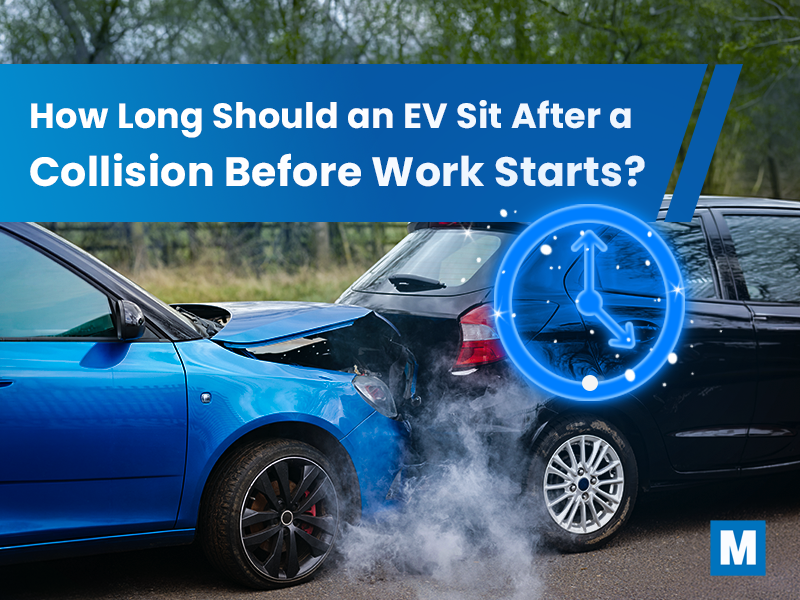
An electric vehicle that’s been in a collision should sit for a minimum of 30 minutes before anyone on your team works on or near it. And that’s under the best-case scenario. If there’s visible damage to the battery enclosure, signs of a thermal event, or any uncertainty about what the impact actually did to the high-voltage system, that window extends to 24 hours or more.
The core issue is that EVs don’t behave like conventional vehicles after a crash. The hazards don’t disappear when the vehicle stops moving, and a car that looks fine sitting quietly in your bay can still be a serious risk if the right steps aren’t followed before anyone picks up a tool.
Why a Powered-Down EV Is Not Necessarily a Safe EV
This is where a lot of shops get into trouble. The vehicle is powered down, the screens are dark, and nothing looks obviously wrong. It’s easy to assume the high-voltage system has taken care of itself. The reality is more complicated than that.
Most EVs are designed to disconnect the high-voltage circuit automatically when a significant collision is detected, but that system depends on sensors and components that can be damaged in the same impact that’s supposed to trigger them. A disconnect that doesn’t actuate is one problem. But even when it works correctly, the vehicle still isn’t immediately safe to touch. High-voltage components like inverters and onboard chargers contain capacitors that hold their charge independently of the main battery pack. Those capacitors can sit at lethal voltage levels for several minutes after shutdown, which is the main reason the 30-minute minimum exists in the first place.
Treating a powered-down EV as a de-energized EV isn’t just a bad assumption. In the wrong circumstances, it’s a dangerous one.
How EV Battery Damage Affects Safe Wait Times
Run-of-the-mill collision situations are one thing. When there’s visible damage to the battery enclosure, the protocol has to change significantly. A battery pack that’s been physically deformed, punctured, or subjected to hard crush forces can develop internal short circuits that generate heat slowly and without any external signs. That’s the part that catches people off guard. There may be no smoke, no smell, no visible swelling when the vehicle arrives, and yet the cells inside are building toward a thermal event that could develop hours later.
For any collision where battery damage is suspected or confirmed, the right move is to isolate the vehicle outdoors, well away from the building and other vehicles, for a minimum of 24 hours before any assessment or repair work begins. Some first responder and OEM service protocols push that window out even further depending on impact severity. The absence of obvious symptoms is not clearance to proceed.
What Verification Looks Like Before Work Starts
Once the waiting period is behind you, the job isn’t done. Verification of the high-voltage system’s status is the mandatory next step, and that means more than a visual check. Before anyone starts collision work on an EV, the following needs to happen:
- Confirm the vehicle is in park and the 12V system is off
- Manually open the high-voltage service disconnect where it’s accessible on that vehicle
- Allow the full capacitor discharge time frame to pass
- Use a CAT III or CAT IV rated meter with insulated probes to confirm voltage at high-voltage components is within the safe threshold specified in the service documentation
- Ensure anyone performing these checks is wearing Class 0 or Class 00 rated insulated gloves throughout the process
That last point deserves its own emphasis. PPE isn’t optional during verification. The whole point of the process is that you don’t yet know for certain what state the system is in, so you work as if it’s live until the meter tells you otherwise.
Workflow and Documentation: The Side Nobody Talks About
There’s a practical reality to EV collision safety protocols that shop managers need to plan around. A vehicle that has to sit for 30 minutes or 24 hours before it can be assessed doesn’t fit neatly into a conventional collision workflow. Storage space, intake procedures, and handoffs between the estimator and the technician all need to account for the hold period before the vehicle arrives, not after it’s already in a bay.
Documentation matters here just as much as the process itself. A written record of when the vehicle came in, what the initial condition assessment showed, how long it was isolated, and what verification steps were completed before work began gives you a defensible paper trail if the repair or the vehicle’s post-repair condition ever gets questioned. Shops that rely on verbal understanding or memory for this are leaving themselves exposed in ways that a straightforward intake checklist would eliminate entirely.
If it’s in doubt whatsoever or there’s no documentation provided, act as if the timer only started the moment the vehicle arrived at the shop.
Don’t Forget the 12V Battery After a Collision
Once the high-voltage system is verified and physical repair work is underway, battery diagnostics are an important part of wrapping up the job correctly. The 12V auxiliary battery in an EV takes real electrical stress during a collision event as safety systems activate and high-voltage disconnects operate. A battery that was already marginal before the impact may be compromised afterward in ways that don’t show up until the customer has already driven off. A failed auxiliary battery means the vehicle can’t complete its startup sequence regardless of how healthy the traction pack is, and that’s a comeback nobody wants to explain.
It’s a step that’s easy to skip when the focus is on structural repair, but it’s also one of the simpler things to catch with the right diagnostic equipment and processes are in place.
Midtronics builds solutions for professional service environments where safety and accuracy both have to show up at the same time. If your shop is handling collision-damaged EVs and you’re building out a process that can hold up to scrutiny, Midtronics has the tools and the expertise to help you do it right. Explore EV safety solutions and make sure your process is as solid as the repairs you’re doing.