
Getting ready for EV servicing? Your clients may pose the question: what’s the difference between AC and DC chargers? Which is better to install in my garage?
Key Takeaways
- EVs can receive power as either AC (alternating current) from standard charging stations or DC (direct current) from fast chargers — but the battery always stores DC.
- AC charging uses the vehicle’s onboard converter to transform grid AC into DC before storing it; DC fast charging bypasses the onboard converter and charges the battery directly.
- The charging speed difference is significant: AC Level 2 chargers typically deliver 7–22 kW, while DC fast chargers can deliver 50–350 kW depending on the vehicle and station.
- Home and workplace charging is almost always AC; public fast charging (for range anxiety situations) uses DC — understanding both is essential for advising EV-owning customers.
- Service technicians working on EVs need to understand both charging architectures to diagnose charging complaints, onboard charger failures, and BMS interactions correctly.
When it comes to electric mobility, two separate electrical currents can be used to fuel an electric vehicle (EV)—AC (alternating current) and DC (direct current). But, before we dive in, there are a two things you should keep in mind:
- The power that comes from the grid, i.e., your domestic socket, is always AC. AC is an electrical current, or flow of charge, that periodically changes direction, i.e., it alternates (Alternating Current).
- Maximum power of 22 kW (requiring 32A main fuse in building)
- The energy that is stored in batteries is always DC (direct current).
- Maximum power of 350 kW (“fast charging”, generally only at larger charge stations)
Also note: no matter whether an EV uses an AC or DC charging station, the EV’s battery will still only store DC energy.
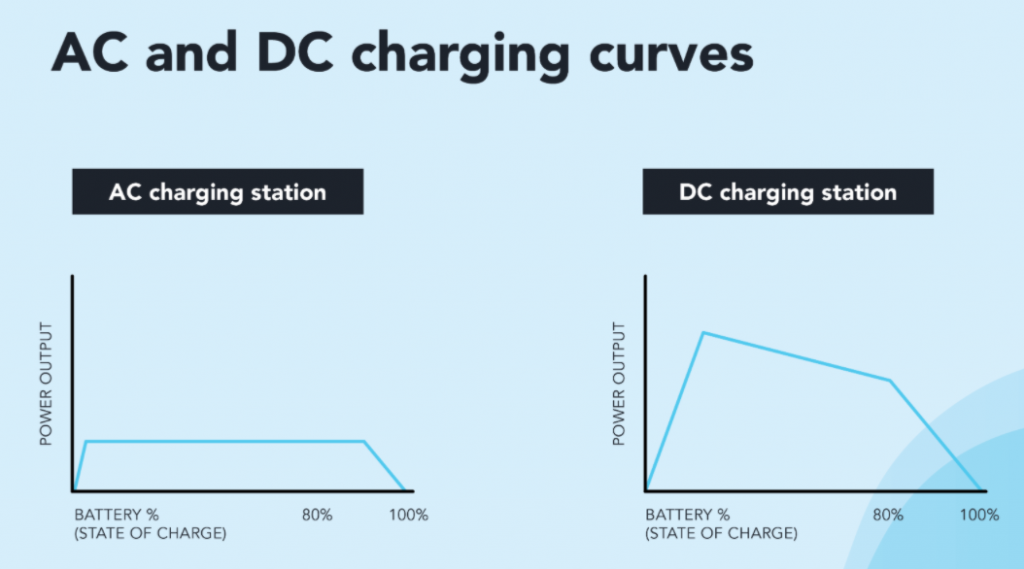
When you use a DC charging station, the conversion from AC (from the grid) to DC happens within the charging station—allowing DC power to flow directly from the station and into the battery. Because the conversion process happens inside the more spacious charging station and not the EV, larger converters can be used to convert AC power from the grid very quickly. As a result, some DC stations can provide up to 350 kW of power and fully charge an EV in 15 minutes.
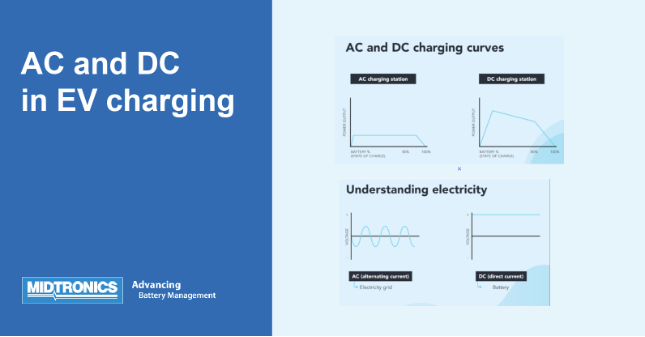
AC charging stations require the onboard charger, which is often limited, to direct current. This means a slower charge. DC charging stations give a quick boost, before levelling down (think of filling up a glass of water; after a certain percentage you need to slow down the pouring, so you won’t spill). A faster charge may develop more internal heat, but other than that the only main difference between the two is cost. This is also why homeowners who opt to get a charging point, generally chose to get an AC charging point installed.
Are you getting ready to service your clients’ electric vehicles? We’re here to help you out. Check out our EV battery service products.
Frequently Asked Questions
What is the difference between AC and DC EV charging?
AC (alternating current) charging uses the vehicle’s built-in onboard charger to convert grid power to DC before storing it in the battery. DC (direct current) charging bypasses the onboard converter and sends power directly to the battery pack at much higher rates. Most home and workplace chargers are AC; most public fast chargers are DC.
Why do EVs only store DC power if they can charge from AC outlets?
EV battery cells require DC to store energy — that’s a fundamental property of electrochemical cells. When an EV charges from an AC outlet, its onboard charger (OBC) converts the AC to DC internally. The convenience of AC charging comes from the simplicity of the outlet and cable; the conversion happens inside the car.
What limits how fast an EV can charge on AC?
The onboard charger is the bottleneck for AC charging. Most EVs have onboard chargers rated between 7 kW and 22 kW. A home Level 2 charger can supply up to 19.2 kW, but if the car’s OBC is rated at 11 kW, that’s the maximum charge rate regardless of what the charger can deliver. DC fast charging bypasses this limitation entirely.
Can any EV use a DC fast charger?
Most modern BEVs (battery electric vehicles) support DC fast charging, but not all — some entry-level EVs and all PHEVs are AC-only. Compatibility also depends on the charging connector standard (CCS, CHAdeMO, NACS). Service technicians advising customers on charging infrastructure need to match the charger type and connector to the specific vehicle.
What does AC/DC charging architecture mean for EV service technicians?
Technicians diagnosing EV charging complaints need to determine whether the issue is in the onboard charger (relevant for AC charging failures), the DC charging inlet and power electronics (relevant for DC fast charge failures), or the BMS refusing a charge for state-of-health reasons. The xHVS-3000 and other Midtronics EV diagnostic tools help isolate the source of charging failures.
Where can technicians learn more about EV charging standards?
The U.S. Department of Energy’s Vehicle Technologies Office publishes resources on EV charging infrastructure, standards, and technology evolution. SAE International maintains the J1772 (AC charging) and J1772 CCS (combined charging system) standards that define how EVs and chargers communicate during a charging session.