
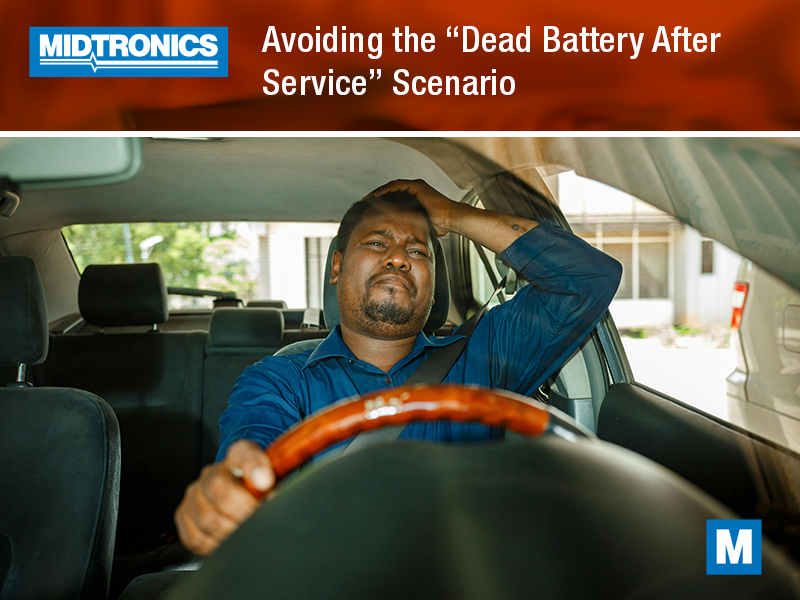
Picture this: a customer arrives to pick up their freshly serviced vehicle. The paperwork is complete, the vehicle looks great, and everything seems perfect. Then they sit down, turn the key or push the start button, and nothing happens. Dead battery. In an instant, the good feeling from a successful service visit evaporates. Frustration replaces satisfaction, and trust in your shop takes a major hit.
Key Takeaways
- A vehicle leaving a shop with a dead battery is one of the most preventable — and reputation-damaging — outcomes a service department can produce.
- Battery drain during extended shop time is a known risk: diagnostic tools, power supplies, and open circuits all draw current from the vehicle’s battery.
- Testing the battery at write-up establishes a baseline and creates a documented record before any shop-related drain occurs.
- Shops that leave vehicles on battery maintainers during extended stays protect both the customer’s battery and their own liability exposure.
- A ‘dead battery after service’ complaint is almost impossible to resolve without a test result from before the visit — documentation is the only defense.
- Making battery testing part of every write-up process costs almost nothing and eliminates the most common post-service dispute shops face.
The “dead battery after service” scenario is one of the most avoidable mistakes a service department can make. Yet it happens more often than you might think. And when it does, it damages your reputation and adds unnecessary stress to your day. The good news is that a few smart steps can make this problem almost disappear.
Why It Happens More Often Than You Think
Vehicle service naturally puts strain on the battery. Technicians often need to leave the ignition on during diagnostics, scan tool updates, or while performing module programming. Even something as simple as keeping doors open for an extended time during interior work can drain power with interior lights and infotainment systems pulling current the whole time.
Short drives around the lot can also cause trouble. A quick move from the service bay to the detail area or delivery zone is not enough to recharge a battery that has been stressed during the repair process. If the battery was already weak when the car came in, it might not survive the extra load at all.
Many times, vehicles come into the shop with batteries that are already marginal. Add a few hours of ignition-on activity, and they cross the line into failure. The customer may have driven in with no noticeable symptoms, but the battery was already close to the edge.
The Real Cost of a Dead Battery After Service
When a customer’s car won’t start after service, it creates a cascade of problems. First, it damages the customer’s confidence in your shop. Even if the battery issue is unrelated to the work performed, it feels like the shop caused it.
Second, it creates extra work. Someone now needs to jump-start the vehicle or bring over a charger. Sometimes, to avoid further embarrassing the shop, the battery is replaced at no cost, cutting into your profits.
Third, it drags down customer satisfaction scores. It only takes one incident like this to lose a customer permanently or trigger a negative online review. In today’s competitive market, a single bad experience can ripple out far beyond the person standing at the service desk.
Your First Line of Defense is Pre-Service Battery Testing
The best way to avoid post-service dead battery scenarios is simple. Test every battery at check-in. A quick test at the start of the visit identifies weak or borderline batteries before service even begins.
Share the results with the customer right away. If the battery is good, great. If it tests marginal or fails, recommend replacement and if the customer declines, document it. That way, everyone is on the same page, and no one is surprised later.
Pre-service testing protects you and gives you an opportunity to add real value for the customer. It also turns a potential comeback into a potential battery sale, boosting both revenue and customer satisfaction.
Protecting the Battery During the Service Process
Once the vehicle is in your shop, the focus should shift to minimizing battery drain during the service. Long sessions with the ignition on and engine off are one of the biggest risks. If you know a scan or update will take a while, connect the vehicle to a battery charger.
Turn off unnecessary loads whenever possible. HVAC systems, heated seats, radios, and lighting systems all pull current. Shut them down if they are not needed for the service being performed.
Even simple practices like closing doors when not working inside can make a big difference. Some vehicles have interior lights or accessories that stay active when doors are open, pulling steady amperage from the battery that adds up.
Monitoring battery voltage during the service is also a smart move. If you notice voltage dropping significantly, connect a charger before it becomes a problem.
Handling Vehicles with Known Battery Issues
If the battery tests marginal at intake and the customer declines replacement, it’s a good idea to flag the repair order. Every technician and porter who touches that vehicle then knows the battery is questionable.
Before delivery, give special attention to these vehicles. Consider topping off the battery with a quick charge to make sure it’s at full strength when the customer arrives.
Documentation is key here. If a customer declines a battery replacement, make sure that conversation is documented in your system. Having it on the work order protects you if the battery later fails and the customer tries to place blame.
Final Step Before Delivery: Confirm Battery Health
Before pulling the vehicle up for delivery, run a final battery test. It only takes a minute. If the battery shows good health, you’re ready to go. If voltage is low or the state of charge is weak, take a few minutes to top it off.
Never assume that just because the car drove into the bay under its own power that the battery is still in good shape after service. Checking battery health at the end of the process is your final quality control step, just like verifying oil levels after a change or torquing lug nuts after a tire rotation.
Communicating With the Customer
If the battery tested marginal or was recommended for replacement and the customer declined, remind them at delivery. Hand them a copy of the battery test printout and explain that while the vehicle is safe to drive, the battery may need replacement soon.
This simple communication does two things. It shows that you are thorough and professional, and it sets realistic expectations. If the battery fails a few weeks later, the customer will remember that you warned them and gave them a chance to address it.
Customers appreciate transparency. It shows that you’re not just interested in selling services but genuinely care about keeping their vehicle reliable.
Leveraging the Right Diagnostic Tools
Professional battery testing tools make all the difference. Midtronics battery testers deliver fast, accurate results that go far beyond simple voltage checks. They measure state of health, cranking ability, and reserve capacity, giving a full picture of battery condition.
Using high-quality diagnostic tools lets you give customers clear, credible information. It also helps technicians make better decisions during service. A good battery test can prevent unnecessary replacements, while a poor test can help prevent embarrassing no-start situations.
Remember, it’s all about ensuring the customer feels well cared for in the most transparent way possible. And while you’re at it, you can help strengthen their trust in your service department, keeping them coming back time after time.
Frequently Asked Questions
Why do batteries sometimes die after a service visit?
Several shop-related activities can drain a battery: OBD scan tools that draw power continuously, technicians leaving doors open with the key in ACC mode, programming procedures that cycle the electrical system, and vehicles sitting on the lot for extended periods without a maintainer connected. Each of these is manageable — but only if the shop has a protocol in place.
How can service departments prevent dead batteries after service?
The most effective prevention is a two-step process: test the battery at write-up to establish a baseline, and connect any vehicle staying overnight or for multiple days to a battery maintainer. This combination protects the customer’s battery from shop-related drain and gives the service advisor documentation to fall back on if there’s a dispute about the battery’s condition.
What’s the difference between a battery maintainer and a charger?
A charger pushes current into a battery to bring it up to full charge — useful when a battery is deeply discharged. A maintainer holds a fully charged battery at its optimal state without overcharging it, which is what’s needed when a vehicle sits in a service bay for hours or days. Midtronics GR8 series and GRX-3000 diagnostic chargers can serve both functions depending on the mode selected.
How should a shop handle a customer who claims the battery died because of service?
Start with the documentation. If the shop has a battery test result from write-up, that’s the baseline. Compare it to a test done after the complaint. If the write-up test showed a marginal battery, the shop can show the customer that the battery was already failing when it arrived — and offer to help them with a replacement. Without that baseline, the shop has no defense and typically absorbs the cost.
Is it the shop’s responsibility if a battery dies during service?
It depends on the circumstances and what was documented. If the battery was already marginal at write-up and the shop didn’t flag it, there’s an argument for shared responsibility. If the shop drained the battery through negligence — leaving a scan tool connected overnight without a maintainer — that’s a service failure. Having a protocol in place shifts the outcome in both cases.
What’s the fastest way to implement a battery test at write-up?
Assign one technician or service advisor to run a conductance test on every vehicle as it pulls into the write-up lane. The Midtronics DSS-5000 or MVT testers take under 60 seconds and print a result on the spot. That result gets stapled to the repair order. The habit takes a week to establish and pays for itself the first time it prevents a ‘dead battery after service’ dispute.