
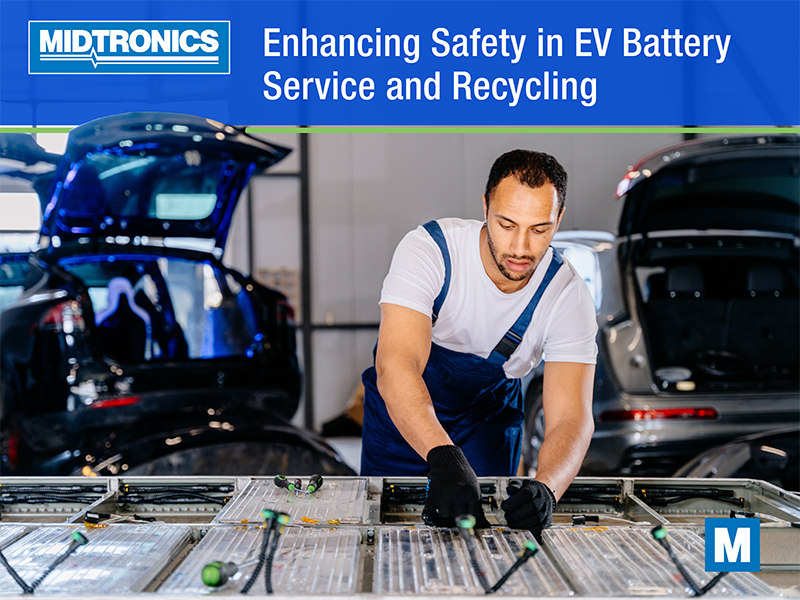
Efficiency and environmental conscience tend to be the prevailing reasons for EV adoption. The drive toward a more sustainable automotive industry often has a singular focus on putting more electric vehicles on the road, reducing dependency on fossil fuels, but key elements of the vehicle lifecycle can be glossed over.
Key Takeaways
- EV battery servicing and recycling both require high-voltage safety protocols — the risks don’t end when a battery is removed from a vehicle.
- Damaged or end-of-life lithium-ion batteries can off-gas toxic fumes and are at elevated thermal runaway risk during handling and transport.
- Technicians must follow OEM-specific discharge and packaging procedures before any EV battery leaves the shop.
- Proper PPE, ventilated storage, and trained staff are non-negotiable for shops handling EV battery recycling streams.
What gets lost in the discussion is that batteries are a finite resource with a finite lifespan. That’s despite early generations already reaching end of life for their battery packs, not to mention accidents and natural disasters condemning many additional EVs to an early retirement. And whether it’s for repairs, decommissioning, repurposing, or recycling, there can be inherent issues that get overlooked.
Midtronics provides tools that make it simpler to diagnose EV battery health and make EV battery reconditioning, recycling, and other service actions safer. Learn more about the challenges facing EV battery repair, and how new tools can help your shop and your customers.
Challenges Facing EV Battery Recycling and Repairs
The technology has been becoming more prevalent over the past two decades, but it’s still a challenge to accurately diagnose and repair EVs, as well as safely go about putting old batteries out to pasture. Among the most perplexing issues are these.
Hazards due to high voltage
Because the energy contained in EV battery packs is immense and extremely dangerous if accidentally discharged, extreme care and dedicated tools and equipment must be used every time to prevent shock or thermal runaway.
Add to the hazard that the personal protective equipment required, from the insulated tools and fire-resistant gear to the specialized glove must be in perfect condition, which isn’t an easy feat to maintain in a busy shop.
Lack of certified staff
Although the training is available, many experienced and skilled technicians still haven’t become certified to work on EVs. It’s an absolute must, tying in closely with preventing accidents due to high voltage. Both dealerships and independent shops alike struggle to find certified techs.
Diagnostic complexities
BMS systems are often quite different between automakers and battery manufacturers. For many EV repairs, the software can be restricted by the carmaker, preventing independent shops from accessing BMS data and proprietary repair procedures. It makes it difficult to service batteries outside of authorized dealerships – adding to the newness of the technology and the lack of trained staff.
Environmental Regulations
Batteries of any kind shouldn’t enter landfills, and an EV or hybrid battery disposed of in this way isn’t just incredibly wasteful – it’s unsafe. Like other batteries including standard 12-volt car batteries, recycling is compelled at virtually all levels of government. However, it’s not uncommon for localities to lack the necessary facilities to process EV batteries properly, adding to a complex process that many times requires special permits for hazardous material transporting.
Cost and Investment in Equipment
As well, the financial aspect of EV servicing takes its toll. The infrastructure to handle and store battery packs is stringent and costly, and both the software and hardware can be difficult to acquire.
How Midtronics Factors In
Electrification isn’t going anywhere with hybridization exponentially and new EVs and battery technology constantly under development. Overcoming these challenges is mandatory to ensure that everyone working on vehicles containing battery packs is safe. But as well as preventing accidents with batteries, there’s also a need to ensure batteries that can be reused or remanufactured are going through that process, that batteries that still have enough capacity to operate next-use solutions are employed that way, and that batteries that are destined for recycling are handled properly.
Midtronics is always focused on battery solutions, and that goes for electric vehicles too. Learn about two tools that make battery servicing and removal inherently safer while providing the most accurate data on battery health.
Touch Voltage Detection Tool
Shock risk increases exponentially when a vehicle has been in an accident or is arriving at a wrecking yard, body shop, or any other facility. How can you ascertain if the battery is discharged or has a live, dangerous charge stored in it? Midtronics xVT touch voltage detection tool has been developed to immediately indicate at a single probe whether the battery poses a risk.
Imagine a service technician approaching an EV that appears completely lifeless. There could still be a deadly HV charge posing a risk. But with one touch of the xVT tool, there’s no question of whether it’s safe or not. It’s perfect for use by tow trucks attending any scene involving an EV, wrecker yard check-in staff, technicians before lifting a vehicle, and dismantlers.
State-of-Health Tool
A battery’s capacity to store energy and its ability to recharge effectively are where its value lies, but buyers aren’t willing to spend top dollar without knowing the battery’s state of health. Can it be remanufactured for reuse, deployed in energy storage solutions like backup power for a community, or is it only good for its resources inside? With Midtronics xOBD-200 State-of-Health Tool, it’s no longer a question.
Simply plugged into the OBD port, xOBD provides state-of-health decisions and performance data along with other key metrics, aiding in providing accurate valuations for the battery pack and helping to unlock information about the best next-use scenarios.
Make EV Battery Recycling Better with Midtronics
At Midtronics, diagnostic, testing, and maintenance equipment makes it safer and more cost effective to service EVs along with providing more accurate data for determining state of health. And when an EV’s battery has reached end of life, shops can mitigate the risk of injury while maximizing recycling or next-use potential.
Find out more about the coming Midtronics tools for EVs, or pre-order the xVT-1000 Surface Voltage Tester today.
Frequently Asked Questions
What safety risks exist when servicing EV batteries for recycling?
End-of-life EV batteries present several hazards: residual high voltage (even “dead” packs may retain dangerous charge), thermal instability in damaged cells, toxic off-gassing from compromised cells, and fire risk during handling. Batteries must be properly discharged, inspected for damage, and packaged to DOT standards before transport to a recycler.
Do EV batteries need to be discharged before recycling?
Yes. Most recyclers and regulators require EV packs to be below a specified voltage (often below 30V for the full pack) before transport. OEM service information specifies the discharge procedure for each vehicle. Some facilities use resistive discharge equipment; others rely on the BMS-controlled discharge function. Never transport a high-voltage pack at full charge.
What PPE is required when handling batteries for recycling?
Class 0 rubber insulating gloves (1000V rated) with leather protectors, HV-rated face shield, insulated tools, and fire-resistant clothing are required when handling HV packs that may still carry charge. Even for batteries believed to be fully discharged, PPE should be worn until residual voltage is confirmed with a calibrated HV meter.
How should a damaged EV battery be stored before recycling?
A damaged battery (from collision, water intrusion, or thermal event) should be isolated from other vehicles and structures, stored in a ventilated area, placed in a non-flammable containment container if available, and monitored for temperature rise. Do not store damaged packs in enclosed buildings. Notify your recycler immediately — some damaged packs require special transport arrangements.
Who regulates EV battery transportation for recycling?
In the US, the Department of Transportation (DOT) regulates lithium battery transport under 49 CFR. Batteries must be properly classified, packaged, marked, and labeled. Some batteries may qualify as “damaged/defective” requiring special handling. Shops should work with a certified hazmat carrier for EV battery transport and consult DOT guidance or a compliance consultant if unsure.
How is EV battery recycling different from lead-acid recycling?
Lead-acid recycling is a mature, streamlined process — most auto parts retailers accept them at no charge. EV lithium-ion recycling is more complex: the packs must be discharged, the cells separated by chemistry, and processed with more advanced methods to reclaim lithium, cobalt, and nickel. The infrastructure is developing rapidly, but shops should identify their regional EV battery recyclers in advance.