
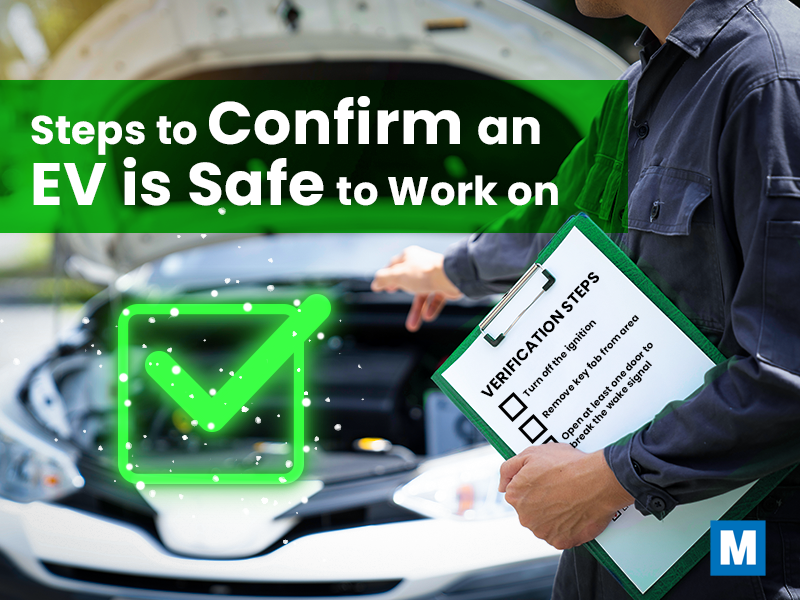
Working on high-voltage electric vehicles isn’t like servicing internal combustion engine cars. Before you touch any orange cables, battery modules, or traction components, there’s one critical question that needs to be answered: Is the vehicle really powered down?
Key Takeaways
- Confirming an EV is safe to work on after shutdown requires more than turning the ignition off — high-voltage systems must be verified as de-energized before any service begins.
- Most EVs have a defined high-voltage shutdown and verification sequence that technicians must follow; skipping steps creates genuine electrocution and arc flash risk.
- The high-voltage system may retain energy for several minutes after shutdown — waiting for the capacitors to discharge is a required safety step, not an optional one.
- Verification tools like the Midtronics xVT-1000 allow technicians to confirm surface voltage is below safe thresholds before touching any HV components.
- After a collision or unusual shutdown, the normal safety sequence may not apply — additional caution and OEM-specific guidance is required before any work begins.
- Shops servicing EVs should have written EV safety procedures in place and ensure all technicians are trained on them before performing any EV-related service.
That might sound obvious, but key off doesn’t always mean no voltage. With many EV platforms, relays, capacitors, and modules stay active long after the driver walks away. If you don’t follow proper verification steps, you might expose yourself or your team to energized circuits, arcing, or worse.
This article walks through the general steps to confirm that an electric vehicle is electrically safe to work on after shutdown. Whether you’re a technician at a dealership, a service manager at an independent shop, or a trainer in an OEM certification program, this is your checklist for working smart and safe.
Step 1: Understand the Platform You’re Dealing With
Before you even open the hood, it’s crucial to understand how that specific EV platform handles shutdown, discharging, and isolation. Every automaker has its own process, with some relying on manual disconnects and others on software-based isolation.
Start by checking:
- The OEM service manual for that specific make and model
- Recommended wait times after shutdown, which can range from 5 minutes to 15 or more
- Whether a service disconnect or manual shutoff is required
If your shop services multiple brands, having a database or printed reference guide can help technicians avoid making assumptions based on what they saw on a different vehicle.
Step 2: Power Down the Vehicle Properly
It’s not enough to just press the Start/Stop button and walk away. Powering down an EV properly means allowing the high-voltage contactors to open, control modules to sleep, and capacitors to begin bleeding off voltage.
Best practices include:
- Turn off the ignition or main power switch
- Remove the key fob from the vehicle area
- Open at least one door to break the wake signal
- Let the vehicle sit undisturbed for the manufacturer’s recommended cool-down period
Some EVs will keep HV relays engaged if the doors are repeatedly opened or if the fob remains close. That’s why it’s good practice to remove the fob from the service bay entirely during shutdown.
Step 3: Disconnect the 12V Battery Safely
This might feel counterintuitive, but pulling the 12-volt battery is often the real turning point in an EV shutdown procedure. That low-voltage battery is responsible for energizing the many of the vehicle’s systems, relays, and BMS.
When removing the 12V battery:
- Wear proper gloves and eye protection, just like you would for any battery job
- Disconnect the negative terminal first
- Secure the cable so it doesn’t accidentally reconnect or contact the chassis
- On some vehicles, you may also need to disable a battery monitoring sensor
Once the 12V battery is out of the picture, the car won’t be able to energize high-voltage contactors. However, that doesn’t mean the high-voltage components are now safe – there’s still more to do.
Step 4: Remove or Open the Service Disconnect
Most EVs are equipped with a service disconnect, which is a physical plug or switch that separates the HV battery pack from the rest of the vehicle. This disconnect is usually bright orange and located near the rear battery module or under the rear seat.
Service disconnect removal tips:
- Only remove the service disconnect after the vehicle has powered down and the 12V battery has been disconnected
- Use insulated gloves and tools
- Wait the OEM-specified discharge time after removal before probing any orange cables
Some service plugs double as fuse cartridges. Others may have an integrated resistor to help bleed off charge when removed. Again, check the service manual so you know what you’re dealing with.
Step 5: Verify Zero Voltage with a Meter
This is the most important step, and the one that gets skipped often. Before touching any high-voltage components, verify with a certified tool that the voltage between HV positive and negative is below a safe threshold, typically under 1 volt. Do not assume it’s safe just because the disconnect is out or the key is off.
To do this safely, use the prescribed safety equipment for handling the EV battery if you need to probe for voltage. Ideally, use a probe that can detect a remaining charge without crossing into safety-compromising territory.
If voltage is still present, you’re not done. You may be looking at a capacitor that hasn’t fully discharged or a faulty disconnect that didn’t isolate properly. Stop and reassess before going any further.
Step 6: Tag the Vehicle as Electrically Safe
Once you’ve confirmed zero volts and the HV system is isolated, mark the vehicle and document it. In a busy shop with multiple people involved, communication is key. Many shops use a printed tag or magnetic placard that reads something like:
“SAFE FOR SERVICE – HV DISABLED – Date/Time: [xx] – Tech: [Name]”
This avoids confusion if another technician starts work on the car later or if the job is passed to another shift. If possible, flag the vehicle in your shop management system so everyone knows its status.
Also, remember to store the service disconnect in a designated, visible location. Some OEMs require that it be locked in a protective case or tagged as a removed safety item.
What Happens When a Step Gets Skipped?
Let’s say a technician on a tight schedule skips the voltage verification step. They followed the shutdown procedure and pulled the service disconnect, but didn’t meter the HV terminals. Unknown to them, a capacitor near the inverter hadn’t fully discharged.
When they began removing the inverter cover, a wrench contacted both terminals, and arced. Fortunately, they were wearing gloves, but the tool was damaged and the technician was shaken.
This kind of scenario underscores the importance of taking the extra two minutes to check for voltage. No warning light or beep can replace that confirmation.
Final Thoughts: Don’t Rely on Silence
One of the most dangerous assumptions in EV servicing is that “if it’s quiet, it’s safe.” Electric vehicles don’t make noise when energized. They don’t give audible, tactile, or visible clues. That’s why a verified shutdown protocol is essential, not just recommended.
As the number of EVs on the road grows, service departments need to treat every high-voltage procedure consistently. Whether you’re diagnosing an inverter fault, replacing an onboard charger, or removing a battery module, confirming that the vehicle is electrically safe is step one, every time.
Midtronics tools and workflows can support your shop’s EV readiness by helping technicians verify system state, validate shutdown, and confirm that the high-voltage system is truly at zero energy.
Because when you treat electrical safety as a habit rather than a task, your shop becomes a safer, smarter place to work.
Frequently Asked Questions
How do you safely shut down an EV before service?
Follow the OEM’s defined shutdown procedure for the specific vehicle. Typically this involves: powering the vehicle off (moving to Park, pressing the power button), waiting for the system to complete its shutdown sequence, removing the 12V battery negative terminal or the HV service disconnect plug (vehicle-specific location), waiting the OEM-specified time for capacitors to discharge (commonly 5–15 minutes), then verifying the HV system is de-energized before proceeding.
How do you verify a high-voltage EV system is de-energized?
Use a calibrated high-voltage surface voltage tester — such as the Midtronics xVT-1000 — to confirm that no dangerous voltage is present at the HV components before touching them. Many EVs also have indicator lights or displays that show HV system status, but these should be treated as secondary confirmation, not the primary safety check. Never rely solely on warning lights or assumed shutdown — test before touching.
What is the HV service disconnect and where is it?
The HV service disconnect is a removable plug or switch that physically breaks the high-voltage circuit, typically located under the rear seat, in the trunk floor, or under the vehicle depending on the make and model. Removing it isolates the battery from the rest of the HV system. Its location varies significantly between manufacturers — always consult OEM documentation before beginning any HV-adjacent service. The disconnect plug should be pocketed or kept with the technician, never left accessible, to prevent accidental reconnection during service.
How long does it take for EV capacitors to discharge after shutdown?
OEM specifications vary, but most manufacturers require a waiting period of 5 to 15 minutes after disconnecting the HV service plug before working near HV components. Some vehicles specify longer wait times for certain conditions. Always use the OEM-specified time for the exact vehicle being serviced rather than applying a generic standard. Voltage verification after the wait period is the definitive confirmation — the timer is a minimum, not a guarantee.
What are the safety risks if proper shutdown procedure isn’t followed?
The primary risk is electrocution from contact with a live high-voltage circuit — EV battery voltages range from 300V to over 800V depending on the vehicle, well above the threshold for lethal shock. Arc flash is a secondary risk when working near energized HV terminals or busbars. These risks exist even on a vehicle that appears powered down, because capacitors in the inverter and onboard charger retain charge after the main system shuts off. The discharge wait time and voltage verification exist to eliminate this residual risk.
Does a collision change the EV shutdown procedure?
Yes — significantly. A vehicle involved in a collision may have damaged HV cables, compromised battery pack integrity, or triggered automatic safety shutdowns that don’t follow the normal sequence. Some vehicles may appear shut down but have live HV circuits due to contactor or BMS damage. After a collision, treat the vehicle as potentially energized until verified otherwise, follow OEM collision-specific shutdown guidance, and if the situation is unclear, contact the OEM technical hotline before proceeding.