
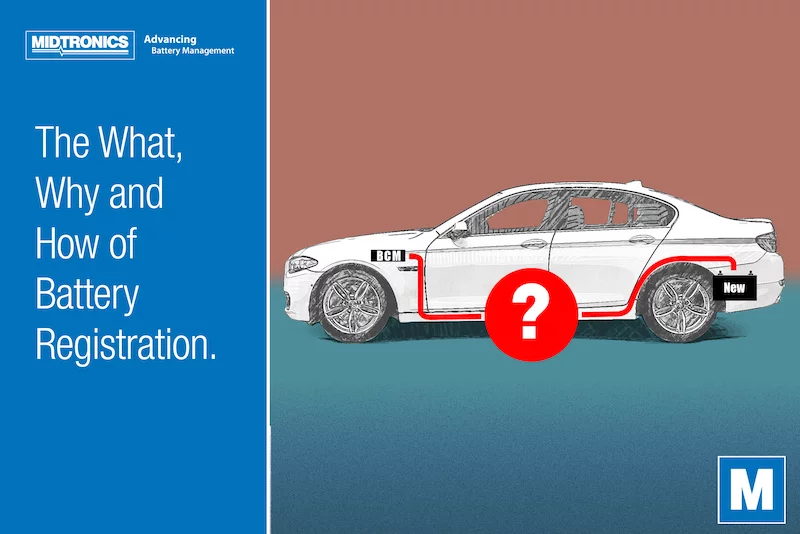
Key Takeaways
- Battery registration tells a vehicle’s engine control module that a new battery has been installed, allowing it to recalibrate charging parameters for the new unit.
- Without registration, vehicles with advanced battery management systems — particularly BMW, Mercedes, and other European brands — may undercharge or overcharge the new battery.
- Battery registration is required any time a battery is replaced in vehicles equipped with energy management systems, not just BMWs.
- Skipping battery registration on applicable vehicles can lead to premature battery failure, poor fuel economy, and customer comebacks.
- Registration requires a scan tool or dedicated battery service tool that supports the vehicle’s BMS protocol — a standard battery tester alone isn’t enough.
- As more vehicles adopt sophisticated energy management systems, battery registration is becoming a standard step in the replacement process for more makes and models.
Changing a passenger vehicle’s 12-volt battery is one of the simplest processes a DIYer or a mechanic can be tasked with. Most car batteries are mounted under the hood, tucked off to one side, but even those mounted in a trunk, under the backseat, or in a wheel well can be changed in under an hour, usually. But for some car models, simply swapping the battery for a new one isn’t the end of the process. It might require a procedure known as battery registration, otherwise the electrical system might not work properly.
What is battery registration, and why is it required on some vehicles? Here’s what you need to know about the process and how registration needs to occur.
What battery registration is
After you swap a car’s 12-volt battery in certain car makes like BMW, Volkswagen, and Audi, a programming procedure needs to take place to let the vehicle’s electrical system know that a new battery has been installed. Batteries experience degradation and wear, and eventually they aren’t able to receive a charge as efficiently as they used to from the vehicle’s charging system. Vehicles equipped with a Battery Management System adapt to the changing requirements and charge rates, delivering energy at a higher rate to keep the battery power topped up.
When a new battery is installed, battery registration essentially resets the charging parameters to account for a perfectly functional battery once again.
Why battery registration is necessary
Cars today have more technology and electrical requirements than ever before, including features like heated seats, navigation and infotainment systems, safety systems, and even some autonomous technology. The demands on the electrical system are quite high, and low or incorrect voltage could cause a system to temporarily shut off or potentially experience a failure.
Another key reason for registering a battery has to do with the auto start-stop function, if equipped. The feature operates based on the state of charge and only shuts the engine off if it ‘sees’ that the battery is full enough and the alternator doesn’t need to run.
A vehicle equipped with a Battery Management System aims to regulate the charging system more precisely to keep the state of charge at the optimal level. That’s why it adapts the charge rate for the battery. The system also performs battery monitoring and protection, intended to keep the battery healthy for longer too.
So, when a battery eventually reaches the point where it needs to be replaced, the electrical system has adapted to operate as efficiently as it’s able to with a battery that isn’t 100% healthy anymore. The electrical system can’t self-diagnose so it won’t automatically detect the presence of a new 12-volt battery. Installing a fresh battery without registering it could set the vehicle into limp mode, shut down electrical systems, or prevent it from starting until registration is complete.
By registering the battery, the charging system re-adjusts to charge at an optimum level again. It prevents overcharging and resets the Battery Management System.
Why is registration required on only certain vehicles?
The requirement to register a car battery was predominantly for makes and models like BMW, Mini, Volkswagen, and Audi. However, this requirement will likely extend to other vehicles in the near future.. If your vehicle uses IBS, or Intelligent Battery Sensors, to monitor the battery’s voltage, current, temperature, and charge, it’s likely going to need battery registration.
For vehicles without battery management systems that monitor those parameters, the charging system doesn’t intelligently adapt to an aging battery’s capabilities. Thus, there’s no need to perform what’s essentially a reset procedure since the charging criteria remains the same.
What happens if you don’t register a battery?
If you decide to replace a battery and don’t register it – assuming it has IBS – you’ll likely have issues of some sort.
- First, it’s possible you’ll experience either an overcharging or undercharging condition. If it’s undercharging, sulfation can occur that degrades the plates inside the battery. If it’s overcharging, the battery can overheat and vent hydrogen and oxygen gases, resulting in the loss of electrolyte. Either way, you’ll significantly shorten your battery life.
- Secondly, you could burn more fuel. If the battery management system isn’t trained to see a new battery, the auto start-stop functionality might not engage, causing your car to use more gas.
- Third, you can have serious electrical issues. Blown fuses, electrical glitches, and system failures are common along with no-start conditions, usually accompanied by a plethora of warning lights on the dash.
How to register a car battery
Battery registration is typically performed by a dealership. Battery registration requires a scan tool (or related OBD-II device) that can communicate with and perform battery registration on the specific vehicle. Different vehicles require different user inputs/battery information and specific scan software.
Electrical systems in vehicles have become increasingly complex, and a healthy battery is foundational to getting the best performance from it. As well, you’ll get the best performance from a battery if it’s cared for and maintained. Test your battery regularly and address any signs of low state of charge or other conditions early on to make your battery last longer.
Frequently Asked Questions
What is battery registration and why is it needed?
Battery registration is the process of telling a vehicle’s battery management system (BMS) that a new battery has been installed. The BMS uses this information to reset its charging strategy — without registration, it may apply charging parameters calibrated to the old battery’s state of degradation, which can harm the new battery.
Which vehicles require battery registration?
BMW is the most well-known, but many European vehicles — including Mercedes-Benz, Audi, Volkswagen, Porsche, and Volvo — require registration when the battery is replaced. The list is growing as more manufacturers adopt intelligent energy management systems. Always check OEM service information for the specific vehicle.
What happens if you don’t register a battery in a BMW?
The BMS continues charging based on the previous battery’s learned state, which was adapted for a degraded unit. This typically means the new battery is undercharged — leading to faster degradation, shorter life, and potentially a customer comeback within 12–18 months.
What tools are needed for battery registration?
Battery registration requires a scan tool or diagnostic platform that supports the vehicle’s BMS communication protocol. Standard OBD-II code readers typically don’t support this function. Purpose-built tools like the DSS-5000 combine battery testing with registration capability for supported vehicles.
Does battery registration apply to hybrid and EV auxiliary batteries?
It can. Some hybrid and EV models with 12V auxiliary batteries also use energy management systems that benefit from registration after a battery replacement. Always consult OEM documentation for EV and hybrid service procedures.
Is battery registration the same as battery coding?
The terms are sometimes used interchangeably, but registration typically refers to informing the BMS a new battery is installed, while coding can involve programming the battery type or capacity into the system. Some vehicles require both steps. Check OEM service procedures for your specific model.