
Enhanced Flooded Batteries (EFB): What are they? How are they different? What are their diagnostic needs?
Key Takeaways
- EFB (Enhanced Flooded Battery) technology bridges the gap between standard flooded batteries and AGM — designed specifically for entry-level Start-Stop vehicles.
- Carbon-paste negative plate technology gives EFBs significantly better charge acceptance and cycling durability than conventional flooded batteries.
- EFBs can’t be swapped interchangeably with standard flooded batteries — they require testers and replacement units that recognize the EFB specification.
- Start-Stop systems cycle the engine at every red light, generating far more charge/discharge cycles than a conventional battery is designed to handle.
- Conductance testing is the recommended method for EFB diagnosis — load testers and visual inspection aren’t reliable enough for cycling-dependent battery technologies.
Start-Stop vehicle needs a different battery because:
- Significantly more starts
- Battery needs to supply power the vehicle when engine (and alternator) are off
- Charge acceptance is important; battery needs to accept charge easily to be able to perform a next Start-Stop cycle
- Regenerative Braking capability, battery or super capacitor should store the energy
EFBs and AGM batteries were designed to better accommodate these Start-Stop applications. AGM batteries are often the “go-to”, however their significant cost has led to the more cost-conscious option of Enhanced Flooded Batteries (EFB).
What are the benefits of EFBs?
The primary benefits of EFB are:
- Improved charge acceptance vs. standard 12V flooded
- Greater cyclic durability vs. standard 12V flooded when operating in a reduced state of charge
- Lower cost than AGM technology
The performance benefits compared to standard flooded batteries are critical in start-stop applications. Studies approximate EFB batteries will provide 85,000 engine starts, compared to 30,000 starts from standard flooded product.
How does EFBs provide Start-Stop performance benefits?
It really comes down to two key physical differences when comparing to standard 12V flooded batteries
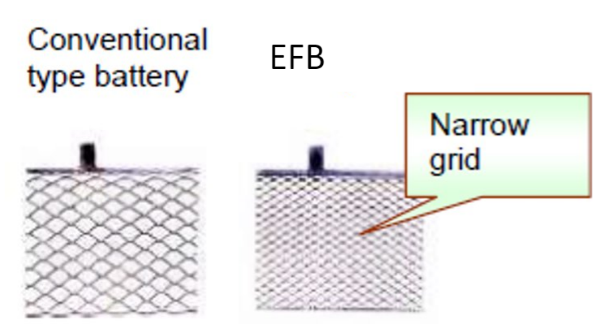
- Narrow grids: holding capacity of active material is raised to prevent active material from becoming softened and dropping, thus increasing charge acceptance.
- Increased number of plates in the battery: increases the reaction area to improve charging performance
It is important to understand, however, that due to how EFBs are constructed and used, they are more susceptible to different types of failure when not managed properly. The reduced acid volume between plates combined with the increased quantity of charge / discharge cycles increases the risk of stratification.
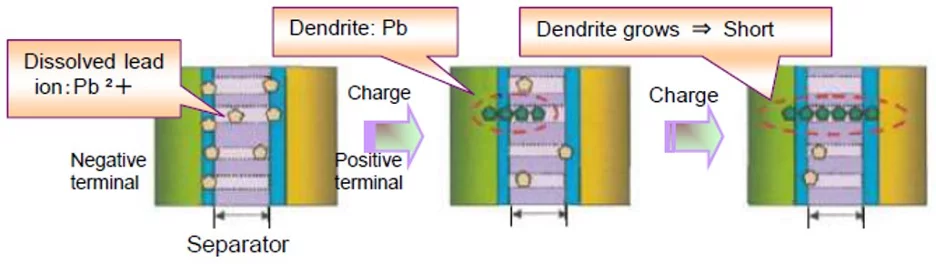
But with EFBs, it does not end there. As batteries discharge the acid concentration decreases resulting in increased lead ions. And when charged, dendrites are created and the lead plates expand. In EFB batteries the plates are constructed so close, that this can allow the dendrites to connect the plates and create shorts.
How do you diagnose EFBs?
As such, Enhanced Flooded Batteries must be diagnosed differently than standard 12V flooded batteries. Standard flooded batteries have a direct correlation between OCV and Specific gravity. EFB batteries are more susceptible to stratification which skews the correlation between OCV and Specific Gravity. If not charged properly, the OCV may increase even though the Specific Gravity does not increase in a proportional amount. This is a result of polarization or stratification and can lead to early life failures.
Enhanced Flooded Batteries (EFB), can help enable many start-stop applications, but due to their performance differences, they come with additional service requirements. As such, it is important you have the proper equipment to accurately diagnose this battery technology.
Frequently Asked Questions
What is an EFB battery and how is it different from a standard flooded battery?
An EFB (Enhanced Flooded Battery) uses a carbon-paste additive on its negative plates, which improves charge acceptance and cycling durability compared to conventional flooded lead-acid batteries. EFBs are built to handle the repeated engine-off/engine-on cycles of Start-Stop systems, where a standard flooded battery would wear out prematurely. They sit between conventional flooded and AGM batteries in terms of performance and cost.
Can an EFB battery be replaced with a standard flooded battery?
No. Replacing an EFB with a standard flooded battery in a Start-Stop vehicle will cause premature failure of the replacement battery, and may trigger battery management system warnings or disable the Start-Stop function. Always replace EFB with EFB — and if upgrading, confirm the vehicle’s BMS can accommodate an AGM upgrade before specifying one.
Why do Start-Stop vehicles require better batteries than conventional vehicles?
A conventional vehicle might cycle its battery a few hundred times over its life. A Start-Stop system cycles the engine at every traffic stop, potentially adding thousands of charge/discharge cycles per year. EFBs are engineered to handle that cycling load without the accelerated plate degradation that would destroy a conventional flooded battery in the same application.
How do you test an EFB battery correctly?
EFB batteries should be tested with a conductance-based tester that supports EFB battery type selection. The MDX-600 Series handles EFB battery type testing and produces accurate state-of-health results without requiring the battery to be fully charged first. Avoid using load testers on EFBs, as the results are less reliable for this battery chemistry.
What happens if you test an EFB battery without selecting the correct battery type?
Testing an EFB with the “flooded” battery type setting applies the wrong acceptance criteria and may return a false pass or false fail. This leads to unnecessary battery replacements — or worse, sending a customer out with a battery that’s actually failing. Always select the correct battery type before testing to get a result you can stand behind.
What standards govern EFB battery performance and testing?
EFB battery performance is defined primarily by SAE International standards including SAE J537 (battery specifications) and SAE J2801 (conductance testing). These define the cycling requirements and test parameters that differentiate EFB from conventional flooded batteries.