
Key Takeaways
- On-board battery monitors continuously track battery state-of-charge and state-of-health in real time — giving fleet managers early warning before a battery reaches a failure point.
- Unlike periodic shop testing, on-board monitoring watches the battery 24/7, capturing degradation events that occur between scheduled PM intervals.
- Telematics integration lets the monitor transmit battery health data directly to fleet management software, enabling proactive scheduling of battery swaps during planned downtime.
- The economics are straightforward: the cost of one no-start event (towing, emergency labor, route disruption) typically exceeds the cost of the monitoring system that could have prevented it.
- On-board monitoring and periodic bench testing are complementary — monitoring provides continuous surveillance, testing provides a verified state-of-health snapshot at each PM interval.
One of the most costly and challenging scenarios for fleet operations personnel is the dreaded call that a truck in the middle of a route will not start or the call from the service depot that the truck scheduled for the next delivery run will not start – all because of a bad battery. But both fleet vehicles were just fine the day before… Or were they?
No-Starts are typically unpredictable and occur without warning. These events are extraordinarily disruptive to the efficiency of fleet operations, which relies on maintaining schedule and timing. No-Starts that sideline a vehicle in route or just prior to scheduled route cost fleets enormous amounts in lost productivity, forfeited revenues, repair & service costs, replacement of damaged goods. All these directly impact the organizational bottom line, easily ranging from $900 – $1,700 per event. Perhaps worst of all, these disruptions in service are a real drag on Customer Satisfaction – who wants to have to explain to Customers their freight could not be delivered or picked up because a battery failed?
What if No-Start Events could be prevented?
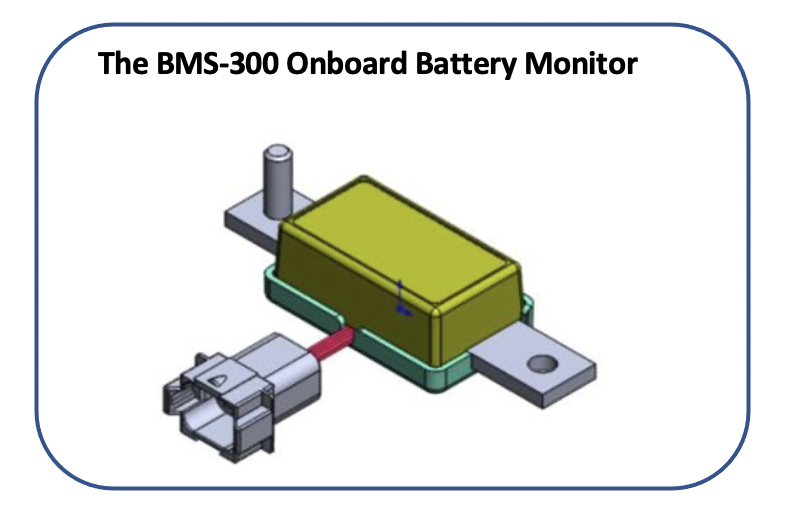
Midtronics has developed the BMS-300 onboard Battery Monitoring System which provides an early warning to fleet operations managers of a battery pack in one of the fleet vehicles that has entered a low state-of-health condition BEFORE it fails. The BMS-300 monitor communicates directly with the truck telematics system or sends messages via the truck’s CAN bus network and signals batteries that need further diagnostics prior to failing.
The BMS-300 captures battery data in real-time, runs algorithms, and communicates the information via the truck’s CAN bus. The monitor measures battery voltage and current draw and is specifically engineered to monitor state of charge. Because it can also measure current, it provides insight into load usage and parasitic draw that are otherwise very hard to detect. The BMS-300 sensor can capture 1,000 voltage and current measurements per second at the battery pack, but it reports only the important info through CAN. The BMS-300 can measure starting currents up to 3,000 amps. As a result, it can report the lowest voltage and the inrush current during every start event. It’s like doing a starting system test every time the engine is started.
BMS-300 Features:
- Single device mounts to one battery or a bank of batteries
- Measures voltage, current, and temperature
- Measures amp-hours of energy going into and out of the batteries
- Calculates conductance (CCA) of battery, starting, and charging system
- Calculates starting capability of the batteries
- Provides warning of low state of charge or poor state of health of batteries
- Reports CAN J1939 messages via direct wiring to a sealed connector
Keeping trucks on routes and on schedule is a key to managing your organization’s operational costs and profitability, as well as maintaining great customer relationships in a very competitive environment. Midtronics’ breakthrough battery health monitoring technology will definitely add to your bottom line and improve your fleet uptime. Click the link to learn more about Midtronics’ BMS-300 Battery Monitoring System. We can guide you through a very simple ROI calculator on the impacts of outfitting your fleet with an onboard early warning battery monitor.
To discuss your specific needs/application, click the button below to fill out the form or email John Philbrook at jphilbrook@midtronics.com.
Where the Cost of a No-Start Really Comes From
The figure most fleets quote for a no-start event covers more than a tow. It includes the driver who is sitting idle, the delivery that runs late, the substitute truck that has to be pulled from somewhere else and the knock-on effect on every stop after that. If the failure happens on the road, add roadside service and the possibility of spoiled or damaged freight.
Because those costs spread across so many budgets, they’re easy to underestimate. Dispatch absorbs part of it, maintenance another part and customer service a third. Pulling those numbers together for a single month often surprises managers and gives a clear starting point for deciding what prevention is worth.
What Early Warning Data Looks Like
A battery rarely fails without leaving clues. The voltage during cranking starts to sag a little more each week. The state of charge at key-off is lower than it used to be. A hidden accessory draws power overnight, and the battery starts the day a little emptier than it should. None of these signs are dramatic on their own, and a driver probably wouldn’t notice any of them.
A monitor that records these values on every start and reports a summary gives maintenance a trend instead of a surprise. The truck that shows a steady decline can be pulled in for a test during its next scheduled stop, and the truck with a stable pattern can keep running.
Questions to Ask Before Adding Monitors
Before fitting monitors to a fleet, it helps to settle a few practical points. How will alerts reach the people who can act on them, whether through a telematics portal, a dashboard or a message to the shop? What thresholds trigger a referral, and who owns the follow-up test? Does the monitor communicate in a format your trucks and telematics provider already support?
Installation matters too. A monitor on a single battery or bank needs a clean, secure connection, and the installation should be consistent across the fleet. Start with a pilot group, such as the trucks with the most no-starts or the most demanding routes. Measure what happens, then expand. A pilot gives you real numbers for the business case without a large commitment.
Frequently Asked Questions
What does an on-board battery monitor actually measure?
The Midtronics BMS-300 on-board monitor tracks three key parameters: battery voltage, current (charge/discharge flow), and temperature. From these measurements it continuously calculates state-of-charge (how much energy remains) and state-of-health (how much of the battery’s original capacity it can still deliver). Both values are transmitted via the vehicle’s telematics system to BMIS for fleet-level tracking.
How early can an on-board monitor detect an impending battery failure?
That depends on how rapidly the battery is degrading and how the alert thresholds are configured. In many cases, monitors flag developing failures days or weeks before they would cause a no-start — early enough to schedule a replacement during planned downtime rather than responding to a breakdown in the field.
Does on-board monitoring replace scheduled battery testing?
No — they serve different purposes. On-board monitoring watches continuously for rapid degradation between PM intervals. Scheduled testing with a tool like the DSS-5000 HD provides a verified conductance-based state-of-health measurement at each inspection point. Together they create a complete picture of battery health that neither approach delivers alone.
Which vehicles benefit most from on-board battery monitoring?
High-utilization fleet vehicles with demanding duty cycles — delivery trucks, transit buses, utility vehicles — see the greatest ROI from on-board monitoring. These vehicles run on tight schedules where a no-start creates immediate downstream disruption. Vehicles that sit for extended periods (seasonal equipment, reserve units) also benefit, as parasitic drain during storage can be caught before it causes a failure at deployment.
How does battery data get from the vehicle to the fleet manager?
The BMS-300 interfaces with the vehicle’s existing telematics system. Battery state-of-charge and state-of-health data rides alongside GPS, engine hours, and other fleet metrics — no separate communication infrastructure required. Fleet managers see battery health in the same dashboard they use to monitor vehicle location and status.
What are the HD solutions Midtronics offers for fleet battery management?
Midtronics’ HD Solutions portfolio covers the full fleet battery management stack: the DSS-5000 HD for in-shop PM testing, on-board monitoring for continuous fleet surveillance, and BMIS for cloud-based data aggregation and analytics. The combination gives fleet operations managers complete visibility into battery health across the entire fleet. For industry testing standards, see SAE International.