
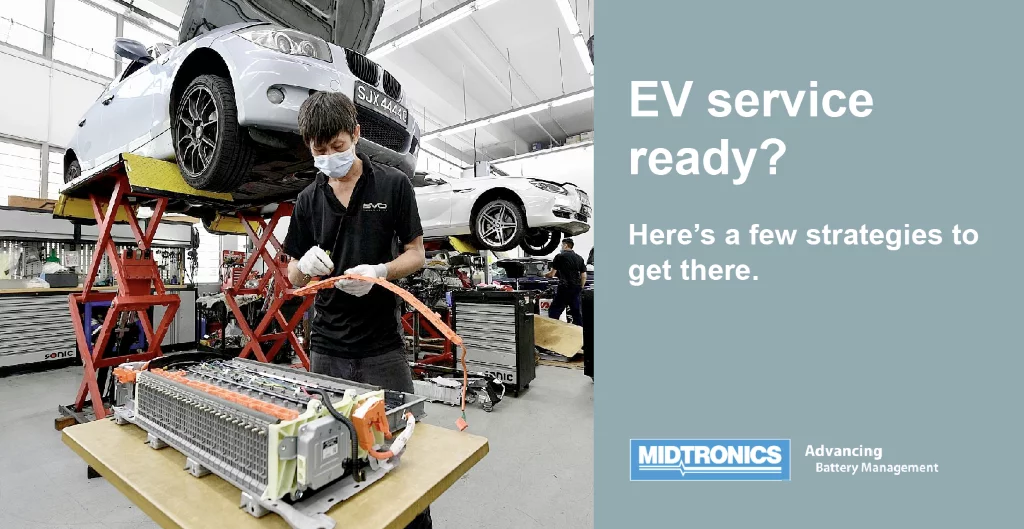
Becoming service ready for the transition to Electric Vehicles can feel like a daunting task. The most pressing question is determining your service strategy for the battery pack. Due to the battery pack’s size, cost, and high voltage it creates service challenges which have resulted in OEMs implementing different service strategies across the globe.
Key Takeaways
- EV battery pack service strategy is the most important decision a dealer or OEM makes when transitioning to electric vehicle service — it drives cost, scalability, and customer satisfaction.
- The four primary EV pack service operations are: diagnosis and module replacement, module balancing, pack depowering (for collisions and shipping), and rescue charging for HEVs.
- Flying doctor, pack replacement, and return-to-OEM strategies are high-cost, low-scale options that don’t support dealers with growing EV lineups.
- In-workshop pack service — with the right training and tools — is the most cost-effective and scalable strategy for dealers committing to EV readiness.
- Midtronics provides the tools, technology, and expertise to support all four pack service applications at the dealer level.
To help point you in the right direction we have identified and described the various service strategies we have encountered.
The “Flying doctor” approach
These are battery service specialists that travel to the stranded electric vehicle, with the goal of getting them back on the road. This strategy can be an extremely costly affair: 1 or 2 technicians, repair tools, food, housing, transportation, a replacement vehicle for the client. The costs add up very quickly with each service event. And the customer may not always be happy relinquishing their vehicle for a prolonged period of service time. It may be an option for OEs with a small presence in the EV space, but it is not scalable for OEs with plans to release many electric vehicle models in their product and service lineup.
Replace the pack
Another option is to simply replace and return the entire high voltage pack. This allows you to avoid pack level service at dealer locations. However, the pack being the most expensive component on the vehicle as well as heavy to ship, makes this option extremely expensive and time consuming for the customer. It is also important to consider local regulations around shipping electric vehicle batteries. Many countries have strict laws around shipping hybrid and electric vehicle batteries. Like the Flying Doctor approach, this option can seem like a reasonable first step, however it is not scalable for OEs with goals to transition their product lineup to electric vehicle models.
Return the car
Then there is the option to return the entire vehicle back to a specialized OEM workshop where the vehicle will be serviced. This is by far the most expensive and time consuming solution, and simply not practical for OEs with long term electric vehicle plans.
Service the pack
The most cost effective and easily scalable service strategy, takes place right in the workshop. When talking about servicing the pack, there are four primary service applications: 1) diagnose and replace pack and/or module issues within the pack 2) balance new modules after replacement; 3) discharge packs in the even on a collision 4) quickly recharge (ie jumpstart) hybrid electric batteries used to crank the vehicle. With training and the right equipment, this option is a viable solution to many OE’s as they are searching for a fast, safe, cost effective, and scalable service strategy.
Midtronics is here to help you become service ready for electric vehicle batteries. As the leading global supplier of EV and HEV dealer service equipment for batteries, we have products, technology, and expertise to help you quickly and safely prepare for the transition to electric vehicle service.
We know the path. We paved it.
Frequently Asked Questions
What are the main EV battery pack service strategies?
There are four primary approaches: the “flying doctor” model (specialists travel to the vehicle), pack replacement (swap the entire HV pack), return-to-OEM (send the vehicle back to a specialized center), and in-workshop service (diagnose and service the pack at the dealer). In-workshop service is the most scalable and cost-effective option for dealers with growing EV volume.
Why is in-workshop EV battery pack service the most scalable approach?
Flying doctor and return-to-OEM approaches involve travel costs, logistics delays, and remove the vehicle from the customer for extended periods. Full pack replacement is expensive and faces shipping regulations in many regions. In-workshop service, backed by the right diagnostic tools and technician training, handles the most common pack service scenarios — module replacement, balancing, depowering, and rescue charging — quickly and locally.
What equipment does a dealer need to service EV battery packs?
The core equipment for in-workshop EV pack service includes a high-voltage diagnostic tool for pack evaluation, a module balancer for post-replacement balancing, a discharge/depowering tool for collision and shipping scenarios, and a rescue charger for HEV battery recovery. Midtronics’ EV Solutions lineup covers all four categories, with products designed for dealer-level use.
What is a rescue charge in EV service?
A rescue charge is a controlled charge of a hybrid vehicle’s high-voltage battery to bring it from a critically low state of charge up to a level sufficient to crank the engine. This is a common need during in-shop diagnostics when the HV battery has been depleted by extended testing. The xRC-3363 is built specifically for this application.
What training do technicians need for EV battery pack service?
EV high-voltage service requires formal training in HV safety procedures, PPE requirements, and OEM-specific pack architecture. I-CAR’s EV curriculum and OEM-provided certification programs are the primary training paths. Midtronics’ service equipment is designed to guide technicians through procedures safely, but formal HV certification is a prerequisite for any hands-on pack work.
How does the DOE recommend dealers prepare for EV service growth?
The U.S. Department of Energy’s Vehicle Technologies Office provides resources on EV service readiness, technician training, and infrastructure planning. As EV adoption accelerates, dealers that invest early in training, tooling, and service strategy development will be better positioned to capture EV service revenue and retain customers through the ownership lifecycle.