
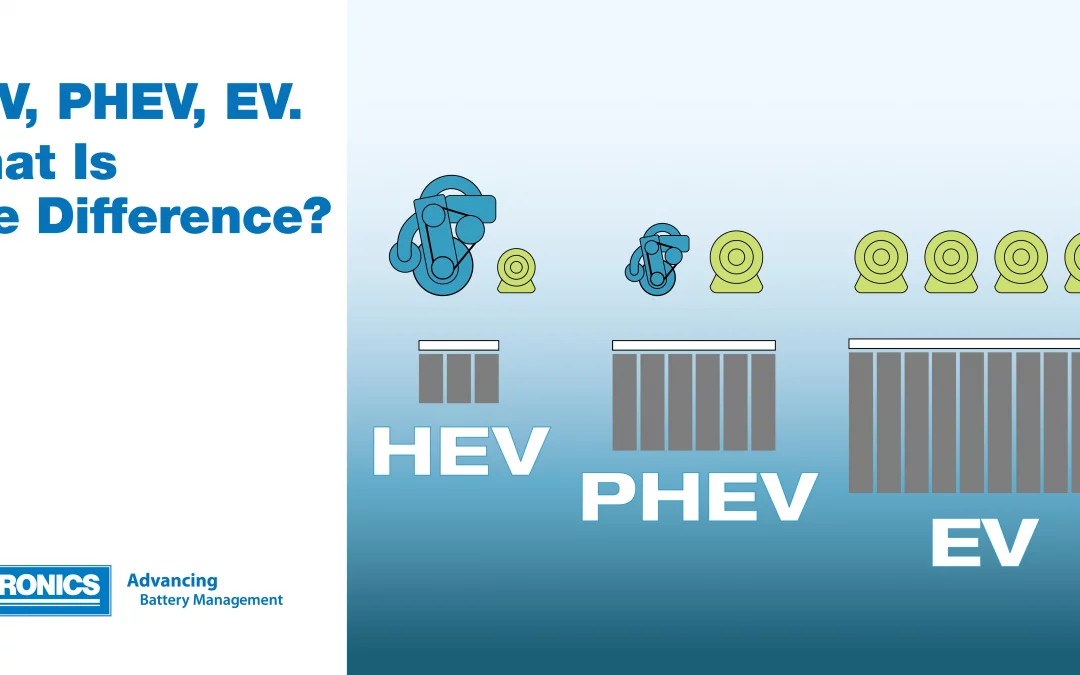
Key Takeaways
- BEVs (Battery Electric Vehicles) run entirely on electricity — no combustion engine, no fuel tank. Their high-voltage battery pack is the sole power source.
- HEVs (Hybrid Electric Vehicles) combine a combustion engine with an electric motor and a smaller battery; the battery charges through regenerative braking and cannot be plugged in.
- PHEVs (Plug-in Hybrid Electric Vehicles) have both a combustion engine and a larger battery that can be charged from the grid — offering an all-electric driving range before the engine takes over.
- Each powertrain type has distinct service requirements: 12V auxiliary batteries in all three, high-voltage packs in BEVs and PHEVs, and HV systems in HEVs that require different diagnostic approaches.
- Technicians servicing a mix of BEVs, HEVs, and PHEVs need tools that support all three battery architectures — including the 12V system that remains critical even in fully electric vehicles.
EV, HEV, and PHEV: What’s the Difference?
There are several types of electric vehicles out on the market, and understanding their differences is important, especially if you are considering purchasing one. There are three main types, and they are:
EV – Electric Vehicle, also known as a Battery Electric Vehicle (BEV)
HEV – Hybrid Electric Vehicle
PHEV – Plug-in Hybrid Electric Vehicle
Below we will go into more detail explaining the above and their differences, as well as their maintenance needs.
EV (Electric Vehicle)
An Electric Vehicle (EV) is a fully electric vehicle that has rechargeable batteries. These batteries are recharged from the grid and are the only source of power for the vehicle, as they do not have a tank for gasoline. When referring to these vehicles, they are also called a BEV.
HEV (Hybrid Electric Vehicle)
Hybrid Electric Vehicles are both electric and gas-powered. The energy that powers their batteries is gained through regenerative braking or while driving using the combustion engine. In a standard gas-powered car, the energy from the braking is lost in the form of heat. This happens by way of the rotors and brake pads. The grid cannot charge these types of electric vehicles.
PHEV (Plug-in Hybrid Electric Vehicle)
PHEVs have both an engine and an electric motor. Like a regular hybrid, PHEVs can recharge their batteries through regenerative braking or with the engine. The primary difference between an HEV and a PHEV is the addition of a charging port into the PHEV. In this way, a PHEV can operate more like a EV, driving off the battery and recharging off the grid, only using the combustion engine when the battery is depleted. PHEV batteries are typically higher capacity than HEV batteries.
Another difference is the distance they can travel before their gas engines turn on. A PHEV will run anywhere from 10 to 40 miles, whereas an HEV will only run less than 2 to 3 miles.
All of the above vehicles will require maintenance for their batteries, also called energy storage systems. To learn more, continue reading below.
Energy Storage System Types
Batteries are essential to EVs, HEVs, and PHEVs. There are lithium-ion, nickel-metal hydride, and lead-acid energy storage systems. In addition to the above, there are also ultracapacitors that are used to provide additional power during acceleration.
Maintenance and Recycling Batteries
To maintain these vehicles, it is important to have them regularly checked per the car manufacturer. So the question most commonly asked is, do EVs require extra vehicle maintenance? The answer to that question is no.
Electric Vehicle Maintenance
Powertrain: Most EV, HEV, and PHEV vehicle manufacturers offer long warranties on powertrains, which speaks to their lasting reliability. The powertrain is simple and requires little maintenance (replacing fluid) when compared to gas-powered vehicles.
Brakes: With the regenerative braking system, brake wear is lower for those that rely on friction braking. However, components of friction braking such as rotors, pads, and brake fluid will still need to be replaced at some point.
Cooling: The energy storage systems on these vehicles use a coolant or refrigerant to keep key parts (charger, inverter, and battery pack) cool. Therefore, maintenance for cooling systems may require infrequent coolant flushes to help the vehicle’s efficiency.
Batteries: As for the maintenance of EV batteries, it is more about prolonging their life. Over time the packs will degrade, and the ability to hold a charge will decrease gradually. To prolong the life of these batteries, you can do the following:
- In storage and in use, minimize high and low temperatures
- Minimize the urge to want to stay at a 100% state of charge/Don’t stay at 0% for very long either
- Although convenient, avoid fast charging
- Avoid storage in high moisture areas
- Avoid damage to mechanical components
- Ultimately, be sure to follow the manufacturer’s calibration instructions/This will often require you to complete an initial full discharge
EV vs. HEV and PHEV Maintenance
When comparing all three electric vehicle types, we can see that the HEV and the PHEV will require more maintenance because it has a conventional combustion engine and an electric drivetrain. However, overall, the maintenance is significantly less when put up against an internal combustion engine.
Recycling EV Batteries
As with all batteries, they do have a life cycle and will need to be recycled. The recycling process for EV batteries typically involves recovering the individual parts and materials of the battery so as not to release hazardous toxins into the environment.
Since the EV market is fairly new, most EVs have yet to reach that point. Therefore, recycling these batteries is still undergoing research; while some manufacturers are reusing the batteries in their plants, others are opening recycling facilities
Frequently Asked Questions
What is the difference between a BEV, HEV, and PHEV?
A BEV (Battery Electric Vehicle) runs solely on electric power stored in a high-voltage battery pack — no combustion engine. An HEV (Hybrid Electric Vehicle) pairs a combustion engine with an electric motor and a self-charging battery (no plug-in); the electric system primarily aids acceleration and captures regenerative braking energy. A PHEV (Plug-in Hybrid) adds a larger battery that can be charged from the grid, providing a meaningful all-electric range before the combustion engine engages.
Do hybrid and electric vehicles still have a 12V battery?
Yes — all three powertrain types retain a 12V auxiliary battery. It powers conventional vehicle electronics (lights, infotainment, control modules) and is required to wake up the high-voltage system on startup. A failed 12V battery will prevent an EV or HEV from operating, even if the high-voltage pack is fully charged. Testing the 12V system is part of every EV and HEV service visit. The xLVS-9000 is purpose-built for 12V diagnostics in EV applications.
How do HEV batteries charge without a plug?
HEV batteries charge through two mechanisms: the combustion engine drives a generator that charges the battery during highway driving, and regenerative braking captures kinetic energy during deceleration and converts it to electrical energy stored in the battery. The battery management system balances charge and discharge to keep the pack in an optimal state-of-charge range at all times.
What is the high-voltage battery service difference between HEVs and BEVs/PHEVs?
HEV high-voltage batteries are typically smaller (1–2 kWh) and operate within a narrow state-of-charge window — they’re designed for power density rather than energy storage. BEV and PHEV packs are much larger (20–100+ kWh) and support deeper discharge cycles. Service procedures differ significantly: BEV/PHEV packs may require full depowering for safe service, while HEV service often focuses on module diagnostics and the 12V system. Midtronics’ EV Solutions tools cover both architectures.
Which Midtronics tools work across BEV, HEV, and PHEV platforms?
The xLVS-9000 handles 12V system diagnostics across all three powertrain types. The xHVS-3000 provides high-voltage pack diagnostics for BEV and PHEV platforms. The xRC-3363 Rescue Charger handles HEV high-voltage battery recovery. Together they give technicians a complete EV service toolkit regardless of which powertrain type comes through the door.
What resources help technicians stay current on EV powertrain service?
The DOE Vehicle Technologies Office publishes technical resources on EV powertrain architectures and service considerations. I-CAR’s EV curriculum and OEM training programs provide hands-on certification for high-voltage system service — a requirement before technicians work on live HV components.