
Key Takeaways
- Midtronics offers three purpose-built EV service tools — GRX-5100, xMB-9640, and xRC-3363 — each designed for different high-voltage service scenarios.
- Pack depowering, module balancing, and rescue charging are distinct service operations; choosing the right tool means knowing which service your shop needs to perform.
- The xRC-3363 Rescue Charger handles the most common HEV scenario: a high-voltage battery too depleted to crank the engine during in-shop diagnostics.
- The xMB-9640 enables module-level service — balancing individual modules within a pack — which is the most efficient and cost-effective approach to pack repair.
- All three tools offer Wi-Fi connectivity and BMIS integration, enabling data capture and cloud-based analysis of every service event.
Looking for an EV service tool? The first step is to decide what service is needed:
- Pack Depowering: Remove energy from a high voltage pack for shipping/logistics, safety and in vehicle crashes
- Module Balancing: Charge/Discharge modules to match the SOC of other modules within a pack.
- Rescue Charge: Charge a high voltage battery to a SOC capable of starting engine in HEV.
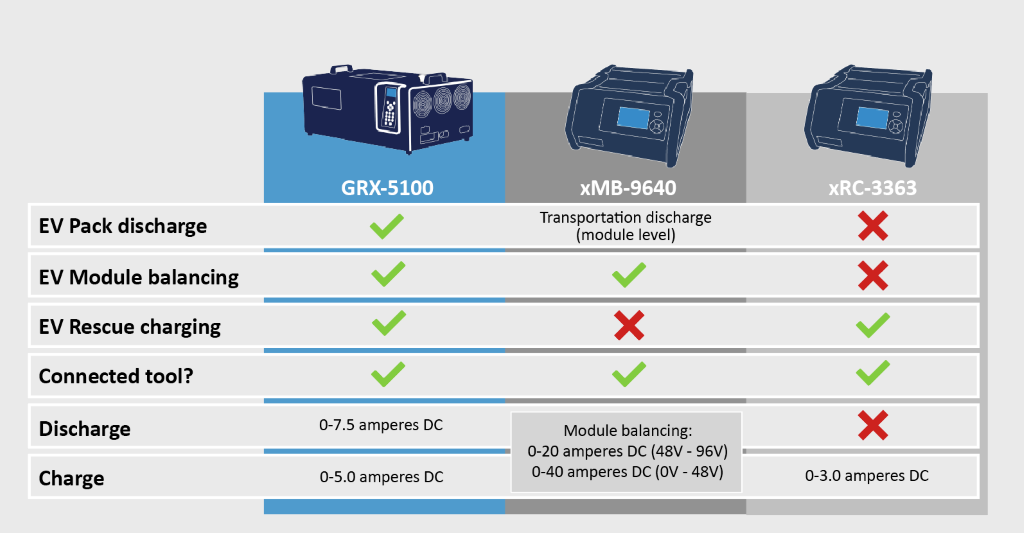
Once you know what services you need, you may wonder what tool options you have. Below have set out some of the main differences between our three EV service tools.
GRX-5100:
With this robust tool you can perform a full battery pack service for hybrid and electric vehicles. Through a simple user menu you can select functionalities such as: Pack Depowering, Module Balancing and Rescue Charging. A USB drive is used for software updates and saving data from each session. With Wi-Fi connectivity, you can also connect to BMIS.
Read more about the GRX-5100.
xMB-9640:
Want more power and speed? With the xMB you service an EV pack on module level in just one workday. EV battery maintenance becomes faster, easier and more cost-effective. With its easy-to-use user interface, the xMB-9640 offers you a variety of functionalities including Module balancing, Transportation Discharge (on module level) and Module diagnostics. Wi-Fi connectivity offers you the option to send e-mail results, get over-the-air updates and make capturing and reviewing battery testing data a piece of cake.
Read more about the xMB-9640.
xRC-3363:
The xRC Rescue Charger enables technicians to quickly, efficiently and safely jumpstart hybrid vehicle high voltage batteries. Rescue charges are often performed when a HV battery state of charge is too low to turn over the engine; a common scenario when technicians are working to diagnose vehicle issues. With Wi-Fi connectivity, you can also connect to BMIS, get over-the-air updates and e-mail results.
Read more about the xRC-3363.
Midtronics offers a wide range of battery service products and battery testing technology for all types of applications and needs. If you’re still unsure which product will best suit your needs, please reach out to our friendly customer support team for assistance.
Frequently Asked Questions
What is the difference between the GRX-5100, xMB-9640, and xRC-3363?
The GRX-5100 is a full-featured pack service tool covering depowering, module balancing, and rescue charging through a single interface. The xMB-9640 specializes in module-level service — faster and more cost-effective when the issue is isolated to specific cells or modules within a pack. The xRC-3363 is a dedicated rescue charger for hybrid vehicles where a depleted HV battery needs a quick charge to enable engine cranking during service.
What is pack depowering and when is it required?
Pack depowering removes stored energy from a high-voltage battery pack to make it safe for service, shipping, or post-collision handling. It’s required any time a technician needs to work on a high-voltage system, when a pack needs to be shipped, or when an EV is involved in a collision and the pack integrity is uncertain. The xPD-1K and GRX-5100 both support depowering operations.
What is module balancing and why does it matter for EV battery packs?
Module balancing brings individual battery modules within a pack to the same state of charge. When modules are mismatched in SOC, the pack’s usable capacity is limited by the weakest module — leading to reduced range, premature cutoffs, and accelerated degradation. After replacing a module, balancing ensures the new module integrates correctly with the existing pack.
When would a shop need the xRC-3363 Rescue Charger?
The xRC-3363 is used when a hybrid vehicle’s high-voltage battery is too depleted to crank the engine. This is common during in-shop diagnostics when the HV battery has discharged due to extended ECU testing or component removal. A rescue charge brings the pack to a state of charge sufficient to restart the engine, without requiring a full pack service. See the xRC-3363 product page for full specifications.
Do these tools connect to the Midtronics BMIS platform?
Yes — the GRX-5100, xMB-9640, and xRC-3363 all offer Wi-Fi connectivity and BMIS integration. Service data from each session can be transmitted to the BMIS cloud platform for record-keeping, trend analysis, and compliance reporting. This is especially valuable for dealers managing high EV service volumes.
What safety standards apply to high-voltage EV battery service?
High-voltage EV battery service should be performed in accordance with DOE Vehicle Technologies guidelines and OEM service procedures. Technicians should be I-CAR or OEM-certified for EV high-voltage service, use appropriate PPE, and always verify the pack is de-energized before beginning any work on high-voltage components.